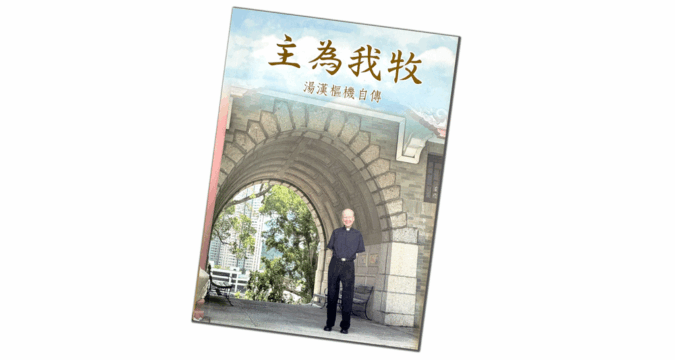
HONG KONG (SE): The Chinese-language autobiography of John Cardinal Tong Hon, bishop emeritus of Hong Kong, titled “The Lord is My Shepherd” [主為我牧], published by the Catholic Truth Society and the Holy Spirit Study Centre, was officially launched on June 28 at the Catholic Diocese Centre.
Together with the cardinal’s earlier books about the history of his services, these volumes serve as a historical testament not only to the cardinal’s ministry but also the development of the Diocese of Hong Kong.
The biographical project began when vicar general, Father Peter Choy Wai-man, commissioned Professor Cindy Chu Yik-yi, from Hong Kong Baptist University, to interview the cardinal, resulting in an English-language biography published in 2024, titled, Cardinal John Tong: Renewal within Tradition in the Catholic Church in Hong Kong.
In response to high demand from local readers for a vernacular version, Cardinal Tong personally undertook the task of expanding the text into a comprehensive new Chinese volume.
Contributing to the Bridge Church
A central feature of this edition is a dedicated chapter documenting historical trips with John Cardinal Baptist Wu Cheng-chung to mainland China in 1985, 1986, and 1994. Drawing on his personal journals from that period, Cardinal Tong reconstructs these journeys to highlight Hong Kong’s vital role as a “Bridge Church” committed to maintaining close pastoral relations with mainland Catholics.
He also quotes Cardinal Wu, who envisioned the Hong Kong Diocese as a “Bridge Church” of pure service, fostering reconciliation and unity between the Church in China and the universal Church through patience and dialogue rather than political friction.
A central feature of this edition is a dedicated chapter documenting historical trips with John Cardinal Baptist Wu Cheng-chung to mainland China in 1985, 1986, and 1994. Drawing on his personal journals from that period, Cardinal Tong reconstructs these journeys to highlight Hong Kong’s vital role as a “Bridge Church” committed to maintaining close pastoral relations with mainland Catholics
Reflecting on his meetings with Beijing leaders during the 1980s, the cardinal recalled that mainland authorities explicitly promised to respect religious freedom in Hong Kong. He told the Sunday Examiner that, as Hong Kong continues to enjoy religious freedom today, navigating these complex historical agreements has always fundamentally relied on a strong foundation of mutual trust.
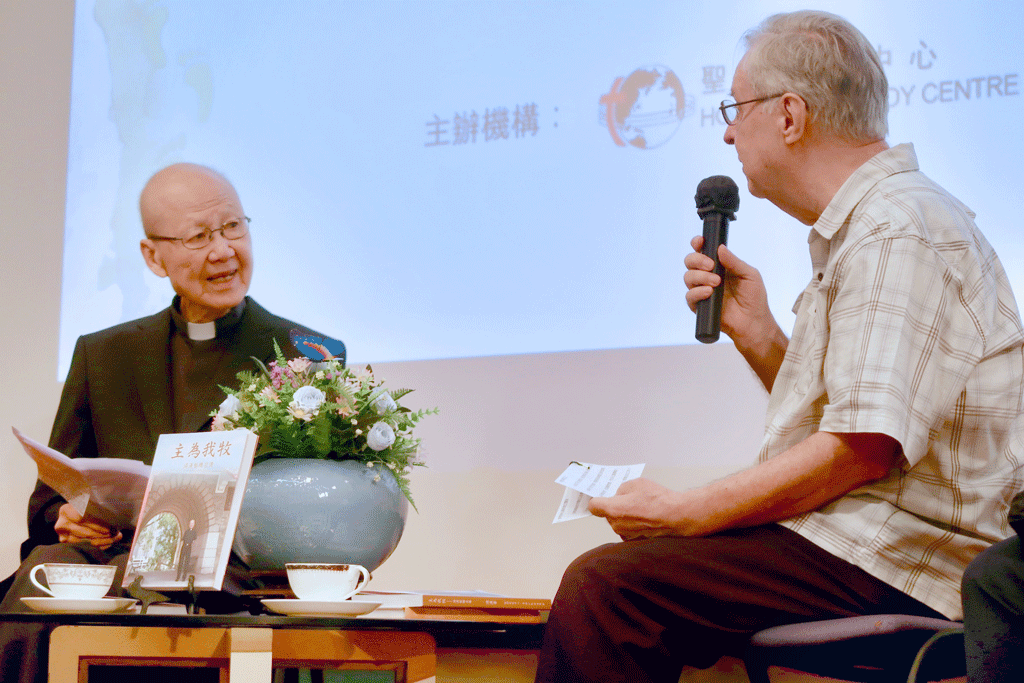
Father Patrick Taveirne of the Congregation of the Immaculate Heart of Mary, interviewing the cardinal during the book-launching ceremony, recalled the cardinal’s bridge-building ministry was often met with challenges as he had been mislabelled as a “leftist” due to his frequent travels to mainland China. Cardinal Tong said he remembered that throughout these trials, Cardinal Wu consistently comforted and encouraged him, reassuring him that his true intentions would eventually become clear to the public.
Cardinal tong recalled that, during his decades of service, he visited the mainland more than a hundred times, witnessing a profound evolution in cross-border freedom. While his initial journeys were born out of necessity, mainland Church personnel eventually gained the freedom to travel to Hong Kong for meetings, studies, and gatherings, and were even accompanied by Hong Kong delegates to foreign countries.
Building an inclusive Church
The autobiography also features reflections from the cardinal’s co-workers at the diocesan Curia and the Holy Spirit Study Centre. His executive secretary for three decades, Sister Emilia Marcelo of the Missionary Sisters of the Immaculate Conception, shared Cardinal Tong’s dedication to serving the universal Church, noting that he travelled to Rome 25 times between 2014 and 2019 as a member of the Roman Curia Council for the Economy.
Sister Marcelo also emphasised the cardinal’s deep advocacy for including non-Chinese communities, highlighting his work in establishing the Diocesan Pastoral Commission for Filipinos in the 1980s and arranging housing to shelter distressed domestic workers.
In his own words, Cardinal Tong fondly recalled his early days as a vicar general travelling to Sacred Heart Church in Sai Kung, where Filipino communities gathered every Sunday to cook, share meals, and celebrate. He noted that the Filipino communities always treated him with immense kindness, reinforcing his belief that human relationships thrive on mutual understanding and shared affection.
This dedication to inclusivity led Cardinal Tong to institutionalise English-language ministries, successfully advocating for English Masses in every parish to ensure the Church embraced all peoples. Looking forward, he suggested that the Church’s history of inclusivity serves as a timely blueprint for welcoming the growing number of Mandarin speakers currently arriving in Hong Kong.
He also expressed his gratitude to his Filipino secretary, who dedicatedly assisted him with various administrative tasks, such as handling immigration documents for incoming priests.
Cardinal’s early formation days
During the launch event, Cardinal Tong shared vivid anecdotes with Father Taveirne about his early formation in Macau, having entered the minor seminary at just eleven years old. He humorously recalled being so small that he felt completely engulfed by the traditional black clerical cassocks all students were required to wear. Even during sports, the seminarians had to play ball games in those heavy robes, which led them to develop clever strategies, such as using the long robes to trap the football close to their feet.
Beyond athletics, his formation in Macau heavily emphasised music education. The seminary required everyone to learn an instrument to prepare them for future service in rural villages where no local pianists would be available. The young Tong was assigned the violin under the strict guidance of an Austrian Salesian musician who visited weekly to drill students on rhythm and tone.
His path continued as he moved to Hong Kong to attend the Regional Seminary for South China, where seminarians enjoyed greater freedom and were no longer obliged to wear heavy black cassocks daily. Under the guidance of Irish Jesuit fathers, their formation extended into the wider community, which was filled with refugees fleeing mainland China.
The seminarians enthusiastically volunteered to help these displaced families, many of whom lived on boats near Wong Chuk Hang and could not afford formal schooling. By opening up the seminary grounds, they established a “roadside primary school” to teach basic literacy to underprivileged children. Many of these children eventually progressed to formal secondary education, an experience that firmly rooted the cardinal’s early priesthood in pastoral openness and service to the marginalised.
Cardinal Tong shared vivid anecdotes with Father Taveirne about his early formation in Macau, having entered the minor seminary at just eleven years old. He humorously recalled being so small that he felt completely engulfed by the traditional black clerical cassocks all students were required to wear
The cardinal also detailed his unique faith journey within a non-Catholic family, where his mother was inspired to join the Church after a profound encounter with a papal representative at the Canossian Sacred Heart School.
Ultimately, both Professor Chu’s English biography and the updated Chinese autobiography capture the defining moments of Cardinal Tong’s life. Both books preserve stories of his wartime childhood, which provided him with the resilience needed to face later challenges. Readers of both versions gain a comprehensive history of the Holy Spirit Study Centre, founded in 1980 under Cardinal Wu’s direction as mainland China began opening up.
The narratives document his close collaboration with co-founders, Father Peter Barry and Father Elmer Wurth of the Maryknoll Society; and Father Angelo Lazzarotto of the Pontifical Institute for Foreign Missions. The texts also record his tenure as the seventh Bishop of Hong Kong, detailing how he formalised four crucial pastoral pillars focused on evangelisation, vocation, serving non-Chinese-speaking communities, and acting as a Bridge Church.
Cardinal Tong has written several books in Chinese and English documenting his decades of service. For example, in 2002, the Holy Spirit Study Centre published Challenges and Hopes: Stories from the Catholic Church in China” providing English readers with a straightforward yet comprehensive account of Catholic life in China.