(UCAN): Indonesia’s National Council for Catholic Education has urged the government to conduct a serious review of its free nutritious meals programme after suspected food poisoning cases sickened hundreds of students and teachers in Papua and Central Java [Sunday Examiner, June 27].
Father Vinsensius Darmin Mbula, chairperson of the council, said the second incident within a week should serve as a serious warning because the programme directly affects children.
“These cases show the importance of seriously evaluating the programme. The government should treat repeated food poisoning cases as a highly serious issue because they affect vulnerable children,” Mbula said on August 5.
The National Nutrition Agency, which runs the programme, has acknowledged 70 incidents affecting more than 5,900 people since it began in January 2025, according to local reports.
“Even a programme claiming to be good will mean nothing if reports of food poisoning continue to emerge,” Mbula said.
These cases show the importance of seriously evaluating the programme. The government should treat repeated food poisoning cases as a highly serious issue because they affect vulnerable children
Father Vinsensius Darmin Mbula
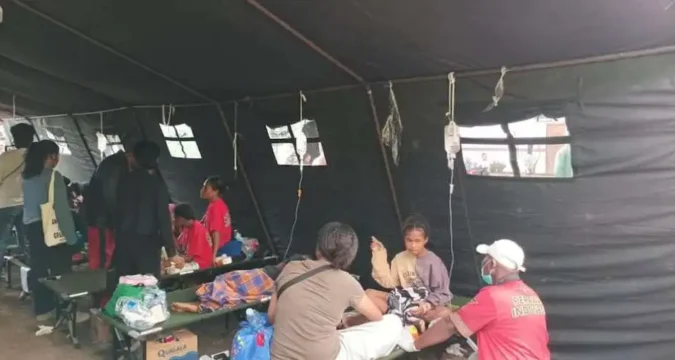
The warning followed reports that children in Depapre district, Jayapura regency, Papua province were treated at health centres and hospitals after eating meals distributed under the programme.
Acting head of the Papua Province Health Service, Berry Wopary, said that at least 527 people from eight villages have been treated since August 4 for symptoms including stomach pain, nausea, vomiting, diarrhoea, and fever.
“There are almost all age groups, but most of them are of primary and secondary school age. Parents are also affected because they take food home to eat with the family,” he said on August 6.
According to Wopari, food samples have been sent to the laboratory, and the examination process is expected to take around one week.
Jeremias Demetouw, a parent of one of the affected students, recounted that “her child is still suffering from diarrhoea. The food eaten was tempeh [fermented soybean cake], watermelon, and egg. Everyone here feels the same.”
In Semarang, Central Java, 707 people, including 693 students and 14 teachers at a state vocational school, were suspected of having food poisoning after eating school meals on July 31.
There are almost all age groups, but most of them are of primary and secondary school age. Parents are also affected because they take food home to eat with the family
Berry Wopary
The National Nutrition Agency temporarily suspended the kitchen linked to the case.
Amnesty International Indonesia has also urged the government to suspend the programme pending a comprehensive review.
Citing data from the Indonesian Education Monitoring Network, Amnesty said more than 37,000 schoolchildren had reportedly been affected by food poisoning linked to the programme between January 2025 and May 2026.
Amnesty Indonesia executive director, Usman Hamid, said in an August 5 statement that the government tends to treat the cases as statistically small compared with the total number of beneficiaries.
However, he stressed that every child has the right to health protection and called for an independent investigation to determine responsibility.
Prabowo Subianto, the country’s president, has promoted the free meals programme, known as Makan Bergizi Gratis [MBG], as a flagship welfare policy to improve child nutrition and increase school attendance.
National Nutrition Agency deputy head Trenggono, a retired general, acknowledged negligence and told reporters on August 6 that he had found “many shortcomings in the kitchen’s management.”
Citing data from the Indonesian Education Monitoring Network, Amnesty said more than 37,000 schoolchildren had reportedly been affected by food poisoning linked to the programme between January 2025 and May 2026
He called for an evaluation to prevent similar incidents but said the president’s priority programme would continue because it is a national programme that all parties are responsible for overseeing.
The government has allocated 335 trillion rupiah [US$21 billion] for the programme this year, targeting about 82.9 million beneficiaries nationwide, including students, pregnant women, breastfeeding mothers and toddlers, according to the National Nutrition Agency.
The agency said the programme had reached nearly 60 million beneficiaries by early 2026 through more than 21,000 Nutrition Fulfilment Service Units, as the government sought to expand one of its largest welfare initiatives.