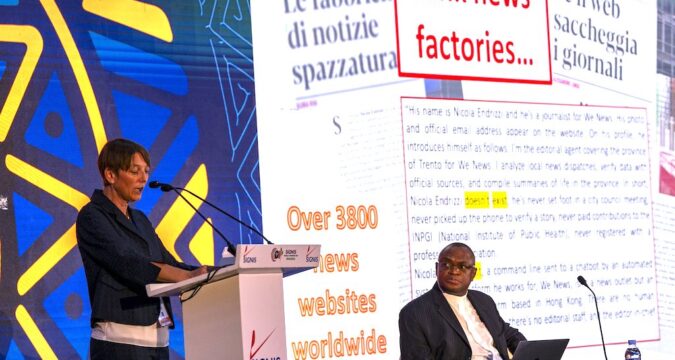
KIGALI (LiCAS News): Dr. Nataša Govekar, theological-pastoral director of the Vatican’s Dicastery for Communication, said more than 3,800 websites worldwide were producing news entirely through artificial intelligence without human oversight.
Speaking during a plenary session of the SIGNIS World Congress in Kigali, Rwanda, on August 4, Govekar said the sites were able to “saturate search engines and social media feeds with thousands of articles per day” while capturing a growing share of online advertising investments.
“This means that resources are being diverted from investigative, constructive journalism and directed to algorithmic intermediaries and pirate platforms,” she said.
Govekar said AI-driven content farms were built to attract traffic rather than pursue truth.
“Content farms do not seek the truth, of course. They seek traffic,” she warned. “They represent a threat to democratic stability.”
She described the spread of automated content as “AI poisoning,” saying it contaminates data used to train artificial intelligence systems and contributes to “a degradation of culture, a trivialisation, a commodification.”
Govekar cited the case of “Nicola Andrizzi,” who was presented on a website as a journalist covering the Italian province of Trento.
“The problem is that Nicola Andrizzi does not exist,” she said, adding that he is just a prompt, “a command line sent to the chatbot by an automated system.”
The Vatican official said AI was also beginning to influence human language and thought.
This means that resources are being diverted from investigative, constructive journalism and directed to algorithmic intermediaries and pirate platforms
Nataša Govekar
She referred to a study that examined more than 7,000 hours of conversations from more than 800,000 podcast episodes and found that words favoured by ChatGPT had increasingly appeared in spontaneous human speech.
“These results show how AI shapes human language quietly,” Govekar said. “Its lexical choices are entering spontaneous spoken communication.”
She said the findings raised questions about whether patterns of thought and association generated by chatbots could also enter daily life as AI becomes more widely used in education, therapy, and other fields.
Govekar said the concerns surrounding AI could not be reduced to technical regulation.
Quoting Pope Leo XIV’s message for the World Day of Social Communications, she said, “The challenge is not technological but anthropological. Safeguarding faces and voices ultimately means safeguarding our self.”
She said digital platforms do more than transmit information. They shape culture and the collective imagination by influencing how people perceive the world and introducing narratives that direct desires and daily choices.
Govekar called for an “ecology of communication” grounded in the principle that “truth is a common good and not the property of those with power or influence.”
The challenge is not technological but anthropological. Safeguarding faces and voices ultimately means safeguarding our self
Govekar
Technology, she said, should be neither demonised nor idolised but used in ways that protect human relationships and serve the common good.
“We must therefore promote an ecology of communication on the level of public policy, on all the social and cultural aspects in our families and schools,” she said.
Govekar also warned that social media algorithms designed to maximise engagement and profit were weakening people’s ability to listen and think critically while increasing polarisation.
She said Pope Leo had explicitly urged people “not to renounce our ability to think.”
Govekar said AI could produce results quickly, but human formation required time, effort, and experience.
“Algorithms offer solutions, but wisdom grows through the strife of mistake, of waiting, even disorientation sometimes,” she said.
She stressed that no technological system could replace the conscience and capacity for self-giving at the heart of human communication.
“No computational system, however sophisticated, can create a heart that gives itself or a conscience that discerns good from evil,” Govekar said.
“Even when machines excel in efficiency, a human face that asks to be gazed upon remains the centre of our history,” she added.
In his message to the SIGNIS gathering, Pope Leo referenced Magnifica Humanitas, recalling that online communication is “not simply a means of transmitting information. It also creates culture, shaping how people perceive the world and profoundly influencing the collective conscience.”
Vatican News reported that the pope encouraged participants to explore practical ways of advancing the conference theme, “Digital Communication for Cultural Harmony and Environmental Wellbeing.”
He expressed the hope that their reflections would lead to communication strategies and tools guided by truth and rooted in respect for the dignity of every person.