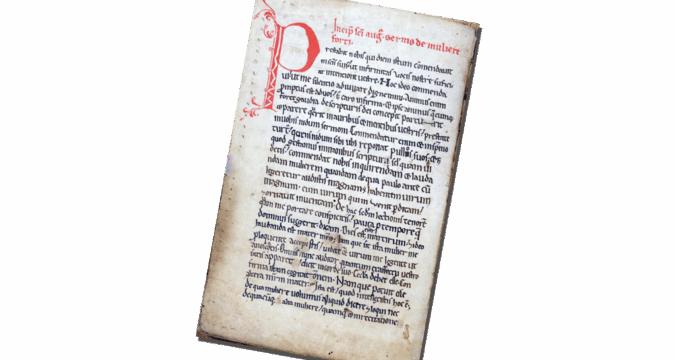
WARSAW (OSV News): Two previously unknown sermons by St. Augustine have been identified in a 12th-century manuscript preserved in Poland, giving scholars a rare new window into the mind of one of Christianity’s greatest theologians more than 1,600 years after he preached them.
The discovery was made in a 12th-century manuscript preserved at the diocesan library in Pelplin in northern Poland after nearly two years of research by scholars from Germany and Austria. The sermons, to be published in a critical edition by the end of 2026, address Saul’s encounter with the Medium of Endor in the Book of Samuel.
The manuscript had long been catalogued in the library’s collection, but no one had studied it in depth before the recent collaboration with scholars from Germany and Austria, Father Jan Walkusz, director of the diocesan library in Pelplin, explained.
“Only the recent research by scholars from Bad Doberan, Würzburg and Vienna showed that the manuscript contains two previously unknown sermons by the Bishop of Hippo,” Father Walkusz said.
We were fascinated, of course, by the idea of having found new sermons of Augustine
Christian Tornau
In 2024, Christian Tornau, a Latin scholar at Julius-Maximilians-Universität Würzburg, was approached by Paul Nebauer of Bad Doberan, who had discovered a medieval manuscript with sermons attributed to Augustine in the diocesan library of Pelplin. Nebauer, a member of the Bad Doberan Monastery Association, has spent years tracing manuscripts from the former Cistercian abbey, whose library was destroyed during the Thirty Years’ War.
During research visits to Pelplin in 2024 and 2025, he identified six manuscripts from Bad Doberan—one of which contained intriguing references to the biblical story of the Witch [Medium] of Endor.
Nebauer found the text unusual and, recognising the need for expert analysis, contacted Tornau. The 12th-century manuscript was copied at Bad Doberan and likely derived from a now-lost manuscript at Amelungsborn Abbey.
Father Walkusz explained that Cistercian monks from Bad Doberan brought such works to Pelplin when founding a daughter abbey there in the 13th century: “That is how this volume containing St. Augustine’s sermons, together with other manuscripts from Bad Doberan, came to Pelplin.”
Of six sermons in the manuscript, four were known to scholars, while two were previously unidentified. “We were fascinated, of course, by the idea of having found new sermons of Augustine,” Tornau said, “but soon turned sceptical because at some places the sermons did not seem to read like Augustine.”
The 12th-century manuscript was copied at Bad Doberan and likely derived from a now-lost manuscript at Amelungsborn Abbey
The team—joined by Dorothea Weber and Clemens Weidmann [Corpus Scriptorum Ecclesiasticorum Latinorum, CSEL]—spent nearly two years transcribing and analysing the texts. Their verdict: “Our final verdict that they are indeed authentic is the result of continuous philological work over almost two years.”
The conclusion was based on liturgical, linguistic, and theological evidence. As Weidmann noted, “This alone, however, is not enough to prove Augustine’s authorship because many inauthentic sermons are attributed in manuscripts to him falsely.” However, “as the preacher is thus indistinguishable from Augustine, we found it methodically safe to accept Augustine’s authorship rather than to invent an anonymous ‘pupil’ or ‘follower’,” said Tornau. “No disciple, no author of later times would have been so familiar with Augustine’s style and thinking,” Weidmann added.
“The discovery of these sermons proves beyond doubt that the carefully preserved collections in Pelplin conceal enormous cultural and religious riches, accessible to researchers from around the world,” Father Walkusz said.
The sermons focus on the debated episode in 1 Samuel 28, where King Saul consults a medium. Augustine explores both traditional interpretations—God permitting Samuel’s appearance or Saul being deceived by an evil spirit—without insisting on a single view: “This openness for divergent interpretations of scripture is characteristic of Augustine in general,” said Tornau.
Weber noted, “Augustine aims not at prescribing a single ‘correct’ interpretation, but at exploring possible interpretations within the framework of Church doctrine.”
The most remarkable insight, according to Tornau, is the suggestion that Saul, after hearing Samuel’s prophecy, may have repented and been redeemed: “It is indicative of Augustine’s independence of mind and his willingness to think of everyone, even those who appear most evil, as capable of salvation through the grace of God. This combines intellectual honesty and episcopal humility in a remarkable and very Augustinian way.”
Related posts:

Questions in Australia over mystery of funds from Vatican

Archdiocese of Manila urges communal prayer for world peace

Solidarity needed to reduce debt of poor nations