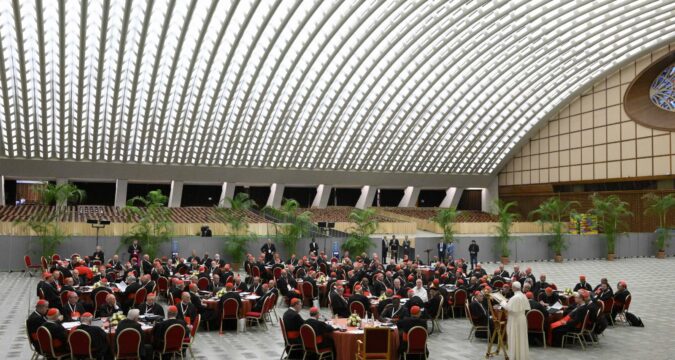
ROME (OSV News): Cardinals from across the globe concluded a two-day extraordinary consistory on June 27, noting that Pope Leo XIV’s initiative to convene the College of Cardinals twice within six months has already achieved a notable result: it has enabled the cardinals to become better acquainted with one another.
The format for the 26–27 June meeting brought cardinals together in roundtable discussions, enabling them to hear perspectives from fellow cardinals from different continents. According to several participants, this approach fostered deeper dialogue and a sense of unity.
In his closing remarks, Pope Leo expressed his intention for the cardinals to continue meeting annually, adding, “what matters is not increasing the number of gatherings, but learning to experience gatherings in which, by listening to one another, we learn together to listen to the Lord.” He stated that he would announce the date of the next consistory later this year.
Discussions over the two days covered a wide range of critical issues: war, poverty, young people, the family, synodality, the Church’s social doctrine, and Pope Leo’s recent encyclical, Magnifica Humanitas. The Pope entrusted the cardinals with the task of implementing the synod’s teachings. “Synodality is not a series of meetings, nor is it a working method. It is a spiritual style. It arises from encounter, grows through listening, and matures through discernment. The real question is not how many conversations we will be able to organise, but what evangelical quality our encounters will have,” he said.
Prior to Pope Leo’s election, the last extraordinary consistory of cardinals was held in February 2014. Pope St John Paul II convened six extraordinary consistories during his pontificate. Pope Francis held one at the beginning of his pontificate, and Pope Benedict XVI held none, although he did assemble the cardinals for closed-door discussions during several ordinary consistories. Pope Leo has now held two—in January and June this year—combining discussion-style roundtables, similar to those used during the Synod on Synodality, with a traditional open forum structure, giving individual cardinals the opportunity to speak to him directly.
…what matters is not increasing the number of gatherings, but learning to experience gatherings in which, by listening to one another, we learn together to listen to the Lord
Pope Leo XIV
Victor Manuel Cardinal Fernández, prefect of the Dicastery for the Doctrine of the Faith, addressed the cardinals at length on Pope Leo’s approach to “just war” in the encyclical. He specifically mentioned the conflicts in Gaza and southern Lebanon, stating that the scale of civilian deaths, the disproportionate number of children killed, and the widespread destruction of homes amounted to “total destruction.”
Cardinal Fernández also criticised both Russia and the United States for invoking self-defence justifications for their involvement in Middle East conflicts.
“What the encyclical now adds with regard to the Catechism’s teachings on just war is that not only the application but also the very notion of legitimate self-defence must be more clearly defined so that it can be understood in its strictest sense,” Cardinal Fernández said. “Thus, the very notion of just war must be revised and refined, lest the classic criteria for a just war become useless and ineffective in today’s world.”
According to a summary from the Holy See Press Office, most groups focused on “the profound fractures of our time, between peoples, nations, within societies, and within families themselves,” and how such divisions cause particular suffering among the poorest, the weakest and the young. Cardinals also highlighted the challenge posed by artificial intelligence, warning that it increases the risk of reducing human beings to “numbers and statistics.”
The consistory’s final session on Saturday afternoon focused on the three-year implementation process of the Synod of Bishops on synodality—a process approved by Pope Francis just ten days before his death in March, and subsequently confirmed by Pope Leo. The plan includes progress assessments at diocesan, national, and continental levels beginning in 2027, culminating in an assembly at the Vatican in October of that year.
What the encyclical [Magnifica Humanitas] now adds with regard to the Catechism’s teachings on just war is that not only the application but also the very notion of legitimate self-defence must be more clearly defined so that it can be understood in its strictest sense,
Cardinal Fernandez
Mario Cardinal Grech, Secretary General of the Synod of Bishops, opened the session by describing synodality as “a missionary resource.” Cardinal Grech said, “It helps the Church to listen more attentively to the questions of humanity, to recognise the signs of the times, to value the gifts of all, and to discern together the steps to be taken,” adding, “In this way, the implementation phase becomes a new stage in the reception of the Second Vatican Council and in the missionary renewal of the Church within the concrete realities of ecclesial life.”
Pope Leo also looked ahead to an October meeting with presidents of bishops’ conferences and the heads of Eastern Churches to discuss marriage and the family. He noted that “some families will also participate to share their experiences” and expressed his hope that “all who attend will prepare themselves by listening attentively and bringing the experiences of families from their own Churches.”
The pope said, “This consistory has been a precious moment, but it must not remain an isolated event. Throughout the Church, we wish to foster spaces where the People of God can listen to one another, pray, discern and walk together. This is the very essence of the process of implementing the Synod.”
He concluded, “This will also be the spirit of the upcoming meeting dedicated to ‘Amoris laetitia’ and of many other initiatives that the Lord will ask us to undertake.”