MACAU (SE): The Church’s media mission must go beyond transmitting information to sharing lives, Ada Chow, representing the Diocesan Audio Visual Communication [DAVC] and the Catholic Social Communication Office [CSCO] of the Diocese of Hong Kong, told the Federation of Asian Bishops’ Conferences Office of Social Communication [FABC-OSC] assembly in Macau.
Reflecting on the First Asian Catholic Digital Missionary Assembly in the Philippines, Chow urged communicators to bring human warmth into their work. She described communion across boundaries of nationality, culture, age and profession.
“This is something no machine or technology can ever replace, because human connection is, at its core, warmth,” she said.
Her challenge was to move from attracting attention to bearing witness, making the Gospel visible through relationships, listening and service.
The Manila gathering, held from September 10-13, took its theme, “We Cannot But Speak”, from Acts 4:20. Organised by Radio Veritas Asia, FABC-OSC and the Dicastery for Communication, it explored digital mission through synodal listening, collaboration and shared responsibility.
This is something no machine or technology can ever replace, because human connection is, at its core, warmth
Ada Chow
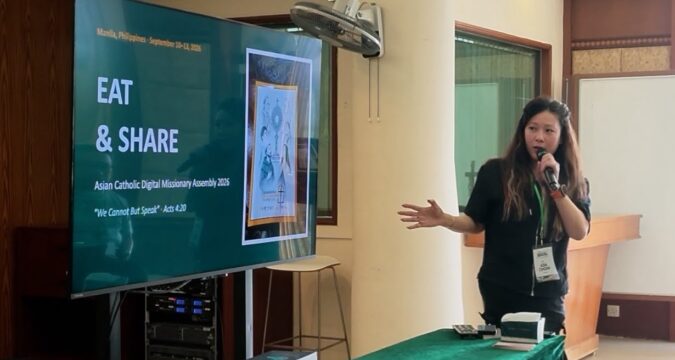
EAT and SHARE
After returning, Chow reflected on two words: “EAT” and “SHARE”, expressing what missionaries receive and what they give.
In “EAT”, “E” stands for evangelisation: speaking of what one has seen and heard. “A” stands for all, reminding participants that mission crosses borders and roles rather than belonging only to specialists.
“T” stands for “temperature”—the warmth that makes faith more than information on a screen. Her presentation explained: “Beyond sharing information, let people feel the warmth of faith.”
Chow linked this warmth with compassionate listening and physical presence. Digital evangelisation should encourage people to leave their screens, respond to suffering and practise charity face-to-face.
“SHARE” identifies five attitudes: service, human being, acceptance, reliance and evangelisation. These mean serving others, putting people first, welcoming diversity, relying on the Holy Spirit and one another, and sharing the Gospel.
Service translates concern into action; acceptance respects cultural differences and personal uniqueness. Reliance challenges the temptation to treat mission as an individual achievement.
Kung Kao Po connects print reporting with video through QR codes. The Sunday Examiner serves English-speaking Catholics, including migrant workers and domestic helpers, through Church news, Asian reporting and spiritual reflection
Both words share one purpose: “We are nourished in order to share, and we share in order to evangelise.”
One mission, different channels
Chow’s emphasis on encounter offers a perspective on social media and Hong Kong’s Catholic newspapers: complementary channels serving one missionary calling.
The Hong Kong national report describes a communication family working through newspapers, video, books, websites and applications. Its contributors include Kung Kao Po and CatCh, the Sunday Examiner, the Diocesan Audio-Visual Centre, the Catholic Truth Society and the Social Communications Office.
Kung Kao Po connects print reporting with video through QR codes. The Sunday Examiner serves English-speaking Catholics, including migrant workers and domestic helpers, through Church news, Asian reporting and spiritual reflection.
Together, these approaches underline a responsibility to recognise the person beyond audience figures. A post can begin a conversation; a newspaper feature can reveal an unheard story; a video can preserve someone’s voice.
The question is therefore not simply how much content is produced, but whether communication respects dignity and allows faith to touch another life
Their missionary value lies in helping people feel welcomed and understood, not merely increasing visibility.
The report also distinguishes technological assistance from human responsibility: artificial intelligence can support production, but people must retain editorial judgement, factual and doctrinal review, and authentic testimony.
Identity before influence
Reflecting on AI, Chow connected awareness and identity through two questions: “Who am I?” and “What am I?”
Her answer began with human dignity: being created in God’s image and redeemed in Christ, rather than professional achievement or recognition.
A communicator’s worth, she stressed, rests in being known and loved by God, not in titles or output. Gifts become a responsibility to serve people and communities.
The question is therefore not simply how much content is produced, but whether communication respects dignity and allows faith to touch another life.
From digital presence to encounter
Chow recalled that participants at the closing Mass pledged to become witnesses rather than mere influencers.
Their pledge called them to speak of what they had seen and heard, listen deeply, collaborate across borders and make digital presence “a living encounter with Christ”. They also committed to sharing the Asian Church’s stories, joys and challenges.
Mission, then, continued beyond publication through listening, learning and encounter. She concluded with Mary’s response—“Let it be done to me according to your word”—as a model of openness.
“Here I am, send me,” she said, hoping participants would become bearers of hope and pass the torch onwards.