Macau anniversary lecture links evangelisation with human encounter, responsible technology and the healing of divisions
MACAU (SE): Authentic communication requires more than technology or polished presentation: it grows from relationships, a shared mission and a genuine encounter with Jesus, Luis Antonio Cardinal Tagle told a gathering marking the 450th anniversary of the Catholic Diocese of Macau.
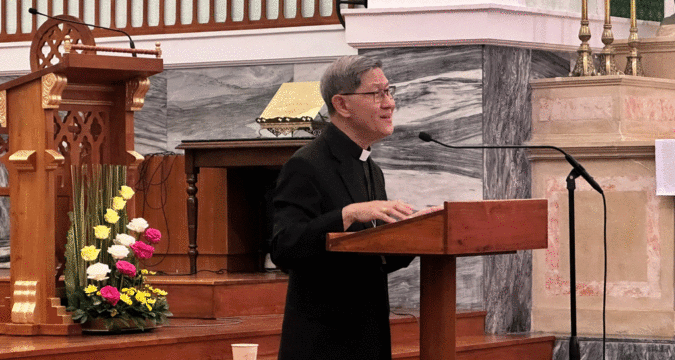
Delivering a lecture entitled “Magnifica Humanitas: Synodal Ways for Evangelisation in Asia,” the cardinal connected the Church’s call to walk together with its responsibility to communicate the Gospel in a world troubled by misinformation, discrimination and division.
The lecture formed part of the anniversary programme, “From Macau to the World: Celebrating 450 Years of Mission & Mercy,” commemorating the diocese’s foundation in 1576.
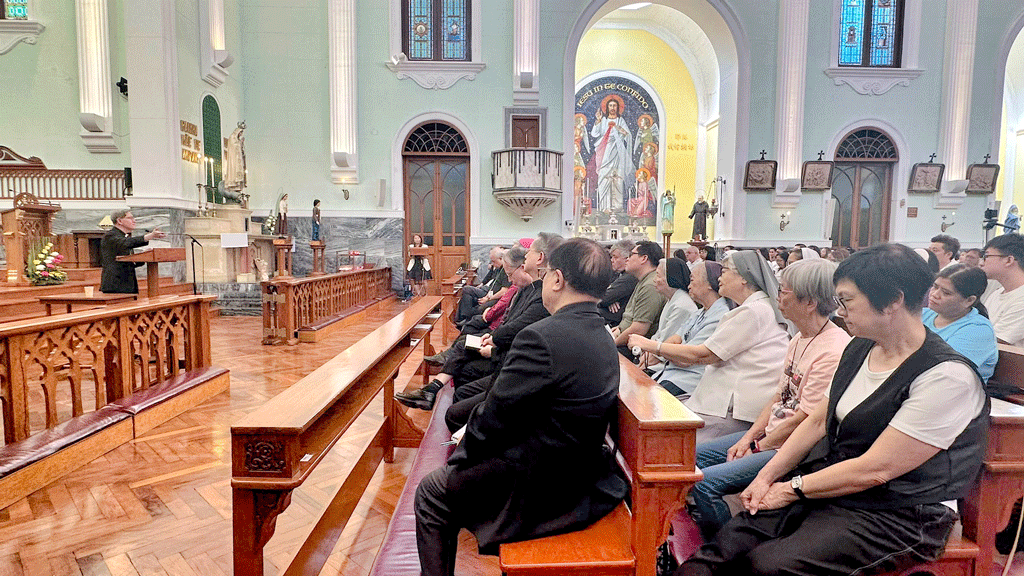
Cardinal Tagle urged Catholics not to be intimidated by synodality, explaining it through the image of people walking together, bringing their different gifts to a common mission.
“Communion, participation, mission,” the cardinal said, inviting participants to repeat the three words.
This was not a new calling, he stressed, but a renewed invitation to live an identity rooted in Scripture, revealed in Jesus and articulated by the Second Vatican Council.
A Church that serves beyond its boundaries
Drawing on Lumen Gentium, the council’s Dogmatic Constitution on the Church, Cardinal Tagle described the Church as both a sign and an instrument of communion with God and unity among the human family.
The gathering itself, bringing together people from different countries and language traditions, offered a visible expression of that vocation.
But communion must extend beyond the Church’s own members.
Cardinal Tagle urged Catholics not to be intimidated by synodality, explaining it through the image of people walking together, bringing their different gifts to a common mission
Recalling a visit to people whose language he did not speak, the cardinal described being asked why Christians from different parts of the world cared about people who did not share their faith.
He answered that Jesus taught his followers to love and serve everyone. A young girl then approached him, expressing a desire to know this Jesus, whom she thought would be a good friend.
The encounter illustrated how solidarity can open a door to evangelisation. Before any formal explanation of the faith, an act of care had prompted questions about the person who inspired it.
Communication is more than technique
Cardinal Tagle cautioned against confusing effective communication with technical sophistication or carefully managed appearances.
Cameras, livestreaming and presentation skills can assist the Church’s mission, he said, but they cannot substitute for an authentic relationship with those being addressed.
He invited communicators—including priests—to examine their motives: were they seeking to serve others, draw attention to themselves or impose their own views?
Cardinal Tagle cautioned against confusing effective communication with technical sophistication or carefully managed appearances
When communication becomes merely a means of controlling an audience or securing a desired response, it risks turning into manipulation.
For evangelisation, the question is not simply whether a message attracts attention, but whether it communicates Jesus and builds communion.
Drawing on the opening of the First Letter of St. John, the cardinal described Christian proclamation as sharing the Word of life whom the disciples had heard, seen and touched, so that others might enter into communion with them and with God.
He challenged listeners to consider how much of their daily exchange of messages reflected an encounter with Jesus—and how much circulated gossip, intrigue or conspiracy.
“Your person really matters,” the cardinal said, urging those using technology not to allow their humanity or their lived witness to disappear behind it.
Sharing Jesus, he explained, should shape the content, tone and means of communication.
“The influencer is always influenced,” Cardinal Tagle observed. A missionary influencer must first be influenced by Jesus and his Gospel.
For evangelisation, the question is not simply whether a message attracts attention, but whether it communicates Jesus and builds communion
The human cost of digital manipulation
The cardinal illustrated the misuse of digital authority with accounts of fabricated content featuring his image.
A former student serving as a seminary rector in Africa had sent him a screenshot of an online conference, thanking him and saying he planned to ask seminarians to watch it.
“I never gave such a conference,” Cardinal Tagle recalled replying to the student.
In another encounter, a woman thanked him for a video promoting medicine for arthritis. He told her he had made no such recommendation.
“I am a bishop. I’m not a pharmacist,” he said.
A missionary influencer must first be influenced by Jesus and his Gospel
Yet she continued to insist that the person in the video was him, despite his denial.
The encounter saddened him because a fabricated digital representation had become more convincing to her than the person standing before her.
Technology itself was not the enemy, he emphasised. The challenge was to use it without losing a sense of the dignity of human beings or the importance of person-to-person relationships.
He pointed to the Incarnation as the fullest expression of God’s communication: the eternal Word entered human life, speaking through ordinary human words and encounters.
Jesus’ empathy and solidarity, he said, reveal that communicating God’s mercy involves drawing close to people in their weakness and vulnerability.
Walking together requires accountability
Within Church communities, Cardinal Tagle warned that competition and attachment to particular groups can divert energy from mission.
With humour, he described rivalries over which choir should sing when a bishop celebrates Mass. Such disputes, he said, place a group’s standing above the good of the parish.
Technology itself was not the enemy, he emphasised. The challenge was to use it without losing a sense of the dignity of human beings or the importance of person-to-person relationships
He called instead for transparency, accountability and evaluation, with everyone willing to accept scrutiny and learn from others.
“I see the other as a companion on the way,” he said.
Authority must serve communion and mission, rather than self-promotion. That responsibility extends to bishops, clergy, lay leaders and those who exercise influence through digital media.
The cardinal also drew on Nehemiah’s leadership in rebuilding Jerusalem’s wall as an example of a shared undertaking: people participated according to their capacities, their concerns were heard and their efforts were coordinated towards a common purpose.
Healing divisions without erasing differences
Turning to the wider challenges facing evangelisation in Asia and elsewhere, Cardinal Tagle warned against tribalism, racism, ethnic discrimination and caste-based exclusion.
Belonging to a family, culture or ethnic community is natural and valuable, he said. The danger arises when loyalty becomes a conviction that everything good belongs to one’s own group and everything evil comes from others.
Authority must serve communion and mission, rather than self-promotion. That responsibility extends to bishops, clergy, lay leaders and those who exercise influence through digital media
He contrasted efforts to impose uniformity with Pentecost, when people heard the proclamation in their own languages. Unity did not require the disappearance of difference.
The Church must also acknowledge these divisions within its own life, he said, citing instances in which communities rejected bishops because they belonged to another ethnic group, or families refused to accept a prospective in-law from a different background.
Parish loyalties can become similarly divisive when attachment to a former priest undermines his successor, or when an incoming priest seeks to erase his predecessor’s work.
Recalling St. Paul’s challenge to factions in Corinth, Cardinal Tagle asked whether such rivalries were consistent with belonging to the one Christ.
Resources intended for mission, he warned, can instead be spent on communities diminishing one another.
He contrasted efforts to impose uniformity with Pentecost, when people heard the proclamation in their own languages. Unity did not require the disappearance of difference
He urged Catholics to begin the work of renewal in their homes, religious communities and parishes: listening, sharing responsibility and keeping Jesus at the centre of their relationships.
A community that walks together towards a common purpose, he said, can become a sign of hope for a divided world—and an instrument for restoring communication