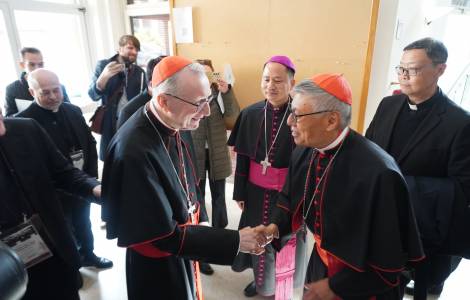
ROME (Fides): Cardinal Stephen Chow S.J., bishop of Hong Kong, believes that the anniversaries commemorated by the Church in China this year invite reflection on formation. At an international conference on November 5 at the Pontifical Urbaniana University—marking the centenary of the episcopal consecration of the first six Chinese bishops by Pius XI—the cardinal delivered a significant address. He explored the concepts of inculturation and Sinicisation, ultimately proposing interculturality as the guiding framework for the formation of clergy, religious, and laity in China.
He began with a historical perspective, recalling that the consecration of 28 October 1926 in St. Peter’s Basilica “marked the beginning of the indigenisation of the Catholic Church in China”. This event led to the establishment of the Chinese hierarchy by Pius XII in 1946 through the apostolic constitution Quotidie Nos, which placed the Chinese Church “on equal footing with others in the Universal Church”.
However, he noted, “these institutional developments did not, by themselves, resolve the continuing challenge of forming Catholics whose faith is deeply rooted in Chinese cultural life, while staying in communion with the universal Church.”
The double anniversary, the centenary of 1926 and the 80th of the hierarchy, may therefore mark, according to the cardinal, “an important milestone for the Church in China and the universal Church to start discerning on the formation of the clergy, religious, and laity in China through synodal dialogue”.
He then asked how such formation could be envisioned, “considering the history of the Church in China and the current government policy of religions in China”. The aim he set out is a formation that meets “the needs of being a universal-local Church and a religious faith that can be readily embraced by the Chinese as one of theirs”.
He cited Buddhism in China as an example, while emphasising that “Christianity is distinctively different from Buddhism”.
Cardinal Stephen then examined three concepts, describing them as “ideas that are not totally new but have already caught the attention of scholars in China”.
The first is inculturation, which he described as “a two-way, ongoing dialogue where the Gospel transforms a culture while allowing local cultural values and expressions to enrich the life of the Church.” He cited the Chinese Rites and portrayals of Mary and her Son in Chinese attire as examples. However, he also acknowledged its limitations: inculturation “raises two related problems, that of the evangelisation of cultures and that of the cultural understanding of the Gospel without the integral participation of faith.”
The second concept is Sinicisation. The cardinal outlined the Chinese Communist Party’s (CCP) policy under the president, Xi Jinping, which has formally promoted the “Sinicisation of religion”—a national strategy requiring religions, including Catholicism, “to align with CCP’s ideology and socialist values, and the spirit of patriotism.” He recalled that Xi referred to this as “the only way” to ensure the country’s long-term stability.
He noted the redesign of places of worship—for example, mosque domes replaced by Chinese-style roofs. He referenced scholars who argue that these campaigns are less about Han cultural assimilation [Han hua] than “Zhongguohua”, understood as “Chinafication” or political alignment with the Party-State.
On this point Cardinal Stephen offered his own assessment: “Being patriotic and faithful believers may help the government to exercise desirable governance for all those who dwell in China insofar that is feasible and appropriate.”
Interculturality, the third concept, forms the basis of the cardinal’s proposal. Drawing on academic definitions, he described it as the “co-construction and negotiation of meanings, attitudes, and perspectives” in intercultural encounters, where participants “open themselves to be influenced or even transformed by other traditions” and critically examine their own ethnocentrism.
He connected this approach to then-Joseph Cardinal Ratzinger, who, in a 1993 address in Hong Kong, advocated for intercultural dialogue over inculturation. According to Cardinal Chow, the future Pope Benedict XVI saw interculturality—”grounded on the universality of natural law and human reason, and a culture of faith in every culture where encounters can take place”—as a platform for cultures and religious traditions to meet and “engage in mutual correction.”
Understood in this way, the cardinal observed, interculturality “shares similarities with Synodality promoted by our Church.”
He then discussed the implications for formation. Intercultural formation, he explained, “takes seriously the Christian faith and the state policy since both shape the circumstances of the Chinese Catholics,” and raises the question of “what being a faithful Catholic who is patriotic towards his or her country could be like.”
Cardinal Stephen described a method based on “intentional dialogues of sincere speaking, empathic listening, identifying converging interests of the common good”, which allows differences to be acknowledged “with respect for later actions.” He noted that “differences that contribute to tensions are often needs unrecognised nor met.”
Such formation should help learners become aware of “their own blind spots” and look for shared desires in order to “create an alternative pathway to address the gaps or tensions productively.”
Recalling the Chinese Rites controversy as “a painful process in history but with helpful outcomes even until today,” he added, “However, the dialogue may not be over.”
The cardinal also referenced his diocese’s experience, where parishes have been asked to use the “Conversation in the Spirit” method to develop their own three-year plans. According to some parishes, he said, this was “an eye-opening experience with greater sense of ownership for the parishioners.”
He concluded that, through intercultural formation, clergy, religious, and lay people “will be equipped with the know-how for them to ‘become authentic’ Catholics and nationals at the same time.”