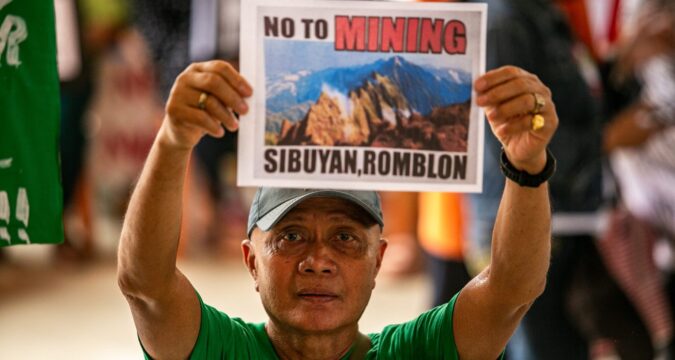
MANILA (LiCAS News): “Sibuyan is not a sacrifice zone,” declared Catholic bishops from dioceses surrounding Sibuyan Island, the Philippines, as they urged the Marcos administration to begin proceedings to cancel Altai Philippines Mining Corp.’s mining agreement if a government review validates concerns raised by affected communities and authorities.
In a joint pastoral statement, the bishops called on the president, Ferdinand Marcos Jr. and acting Environment secretary, Juan Miguel Cuna to commission an independent review of APMC’s compliance with mining and environmental laws.
They warned that large-scale metallic mining threatens Sibuyan’s forests, watersheds, biodiversity, communities, livelihoods, and surrounding seas.
Bishop Narciso Abellana of Romblon led the statement, joined by bishops from neighbouring dioceses and Caritas Philippines.
Among the signatories was Bishop Gerardo Alminaza of San Carlos, president of Caritas Philippines, along with bishops from Capiz, Kalibo, Calapan, Boac, San Pablo, Lucena, Gumaca, and San Jose de Antique.
They warned that large-scale metallic mining threatens Sibuyan’s forests, watersheds, biodiversity, communities, livelihoods, and surrounding seas
They called for an “immediate, comprehensive, independent, transparent, science-based, and participatory review” of APMC’s mineral production sharing agreement, environmental permits, compliance history, social acceptability, and cumulative environmental and social impacts.
If the review confirms legal, environmental, contractual, or regulatory issues already raised by affected communities and competent authorities, the bishops requested the government to “initiate without delay the proceedings for the cancellation of MPSA No. 304-2009-IVB, with full observance of due process.”
The mining agreement, granted in 2009, covers approximately 1,580.80 hectares in San Fernando on Sibuyan Island. The project has faced regulatory interventions and environmental compliance disputes, including a cease-and-desist order imposed in 2011 and lifted in 2021.
The bishops also rejected claims that a 2025 Supreme Court ruling denying a Writ of Kalikasan petition against APMC cleared the project of environmental concerns.
As we celebrate the 500 years of Christianity in the Philippines. The Chaplaincy to Filipino Migrants organises an on-line talk every Tuesday at 9.00pm. You can join us at:
https://www.Facebook.com/CFM-Gifted-to-give-101039001847033
They noted that the court itself said its decision “does not mean…that We condone the environmental issues hounding San Fernando, Sibuyan Island, Romblon.”
The bishops also rejected claims that a 2025 Supreme Court ruling denying a Writ of Kalikasan petition against APMC cleared the project of environmental concerns.
They emphasised that the ruling should not be interpreted as confirming the environmental safety of large-scale metallic mining on Sibuyan.
The ruling also does not remove the authority of the Department of Environment and Natural Resources and other agencies to review APMC’s agreement, enforce environmental laws, or determine if grounds exist for administrative action.
The bishops cited a separate Supreme Court ruling recognising that local governments may evaluate mining applications, raise concerns or objections, and withhold approval when their concerns are not addressed.
Sibuyan’s long geological isolation has produced high levels of endemism. Its forests, watersheds, rivers, mangroves, reefs, and surrounding seas comprise an interconnected ecosystem. Mount Guiting-Guiting Natural Park is recognised as a Key Biodiversity Area.
The bishops warned that habitat loss on an island with unique species could have irreversible consequences. “If a species found only in Sibuyan disappears from Sibuyan, it disappears from the Earth.”
The bishops called for meaningful participation, access to information, and transparency throughout the lifecycle of any project
They stressed that Sibuyan residents should not be treated merely as stakeholders consulted after major decisions, but as “rights-holders and indispensable participants in determining the future of their island, their livelihoods, and the ecological inheritance of their children.”
The bishops called for meaningful participation, access to information, and transparency throughout the lifecycle of any project. Where Indigenous Peoples and ancestral domains are affected, rights under Philippine law, including free, prior, and informed consent, must be respected.
The Church leaders recalled the killing of San Fernando municipal councillor Armin Marin during an anti-mining protest in Barangay España on 3 October 2007.
Marin was an environmental advocate and president of the Parish Council of the Laity of the Parish of Our Lady of Remedies. The bishops stated, “never again should the defence of creation cost another human life.”
They called for protection of environmental defenders, Indigenous Peoples, local communities, fisherfolk, farmers, lay leaders, clergy, civil society, and public officials who peacefully participate in environmental governance.
The bishops argued that protecting Sibuyan does not mean rejecting development. Authentic development, they said, cannot force communities to choose “between jobs and water, investment and food security, revenues and biodiversity, or short-term economic promises and the rights of generations yet unborn.”
They pledged support for sustainable agriculture and fisheries, community-based ecotourism, renewable energy, ecosystem restoration, and responsible local enterprise.
“The wealth of Sibuyan cannot be measured solely by the minerals beneath its soil,” the statement read, describing its forests, rivers, watersheds, biodiversity, farms, fisheries, culture, communities, and surrounding seas as “a living inheritance whose loss may be irreversible.”