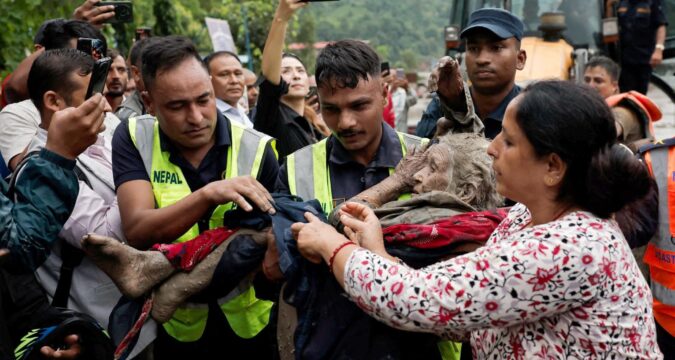
(SE): “It is the worst disaster in the country’s history. It was terrible. A flood coming down from the mountains and rushing violently downstream swept everything away: people, homes, bridges and infrastructure. Villages, markets and roads have been wiped out. It is a deep wound for the nation,” said Father Silas Bogati, apostolic administrator of the Vicariate of Nepal, Fides reported on August 27 following the floods that struck the Nepal-Tibet border area on August 26.
The devastating floods were reportedly triggered by a glacial collapse—ice and rock gave way high in the Himalayas. The resulting debris temporarily blocked the Bhote Koshi River, creating a natural dam that later burst, unleashing a violent torrent of mud, water and debris downstream.
The torrent swept through Nepal’s Rasuwa and Nuwakot districts before reaching areas further downstream, including Chitwan. Across the border in China, the flood struck Gyirong County in Tibet, including the Gyirong Port area. According to Fides, experts clarified that the seismic signal first detected was not caused by an earthquake, but by the glacial collapse and ensuing debris flow.
According to Nepaldisaster.com and NDTV.com, as of 1 September 2026, 903 people have been confirmed dead and 4,247 are missing, with 10,451 rescued and 1,473 injured, following the torrent of water, mud and debris that swept through communities near Nepal’s northern border with China. NDTV also reports over 1,000 dead, 3,916 missing, and 11,814 rescued.“We are shocked. We are praying for all those who are missing and for those who have died. My heart is with those who are suffering because of this catastrophe. There are around 25 Catholic families in the disaster area. They appear to be safe, but we are very concerned about them. We entrust them to God, pray for their safety and will do everything we can to help them,” Father Bogati said.
On August 27, Pope Leo XIV voiced his profound sorrow over the tragic loss of life and widespread destruction wrought by the flash floods, in a telegramme signed by the Vatican’s secretary of state, Pietro Cardinal Parolin, Vatican News reported.
It is the worst disaster in the country’s history. It was terrible
Father Silas Bogati
Pope Leo entrusted the souls of the deceased to the mercy of God and extended his deepest condolences to the bereaved families. He further assured all those suffering from the disaster of his spiritual solidarity, offering prayers for the emergency personnel engaged in ongoing search-and-rescue operations.
Caritas Nepal, said on August 27 that it was actively distributing emergency relief supplies—including food packages, drinking water and hygiene kits—to families in the hardest-hit districts. The organisation also deployed teams to assess needs and coordinate with local authorities to ensure aid reached the most vulnerable.
Rescue and aid efforts were hampered by settlements being completely inundated and crucial infrastructure—roads, bridges and power stations—destroyed or severely damaged.
A report from LiCAS News cited the US Geological Survey, which attributed the disaster to a glacial collapse and subsequent debris flow. Initially, the seismic activity was mistaken for an earthquake. “The event was initially reported as a magnitude 4.4 earthquake,” the agency noted.
“Additional analysis of nearby seismic stations, long-period seismic waves, and satellite imagery led to the determination that the seismic event was instead a glacial collapse and debris flow, and that no earthquake had occurred,” it added.
Rescue and aid efforts were hampered by settlements being completely inundated and crucial infrastructure—roads, bridges and power stations—destroyed or severely damaged
Officials cautioned that another flood could occur due to an upstream blockage.
“With a blockage still lodged upstream on the Nepal-China border river, authorities warn a second flood may occur,” said Qianggong Zhang, head of climate and environmental risks at the Kathmandu-based International Centre for Integrated Mountain Development, LiCAS News reported.
The Nepali Army conducted rescue flights and evacuated residents from high-risk areas near the river. Meanwhile, authorities in Tibet mobilised almost 800 emergency personnel, 150 vehicles, sniffer dogs, and speedboats, according to Chinese state media.