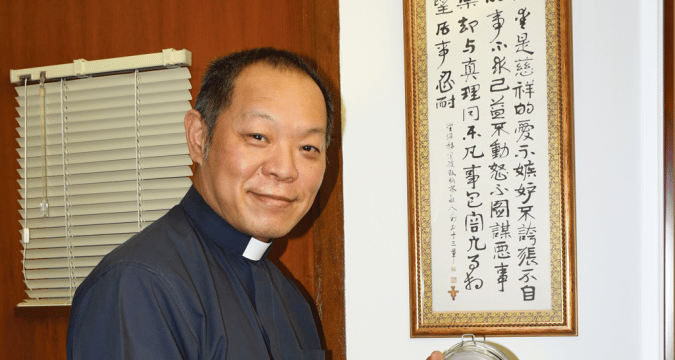
By Father Joseph Chan Wing-chiu
In life, we always like looking on the bright side. We hope for a smooth career, good health, a happy family, and fruit from our hard work. It comes naturally to us to chase success, wealth, and peace, just as we naturally push away failure, illness, poverty, and death. Given the choice, who would choose to suffer? Who wants to lose? Who would willingly take a path full of setbacks?
That is why, in this Sunday’s gospel, we hear Peter trying so urgently to stop Jesus. When Jesus first clearly warns his disciples that he must go to Jerusalem, suffer at the hands of the elders, chief priests, and teachers of the law, be killed, and be raised on the third day [Matthew 16:21], Peter immediately pulls him aside. “Never, Lord!” he says. “This shall never happen to you!” [Matthew 16:22].
Peter’s reaction is deeply human. To the Jews of the time, a truly successful Messiah was supposed to arrive in triumph and set up a glorious kingdom. How could he fail? How could he suffer? How could he be nailed to a cross? Yet Jesus answers sternly, “…you do not have in mind the concerns of God, but merely human concerns” [cf. Matthew 16:23]. The issue is not that Peter lacks love for Jesus, but that he only sees one side of life. He longs for glory, but rejects the cross; he longs for resurrection, but rejects death; he longs for victory, but rejects defeat.
Are we not just the same today?
Our society puts immense value on efficiency, achievement, and competition. From an early age, we are taught to push for better grades, higher status, and better pay. We strive for good health and try to dodge growing old; we pursue wealth and try to escape hardship; we aim for success and run from failure. Yet the truth of life is rarely a one-way street.
Often, it is only after experiencing failure that we learn what real success is. Only through illness do we realise that health is not something to take for granted. Hardship teaches us gratitude and care, and facing death pushes us to think seriously about what it means to be alive. The fullness of life never comes from having only one side of it. Instead, we grasp life’s deeper meaning as we move between light and dark, gain and loss, life and death.
Jesus walked this exact path. He did not dodge human pain or bypass life’s dark nights. He accepted human weakness, misunderstanding, betrayal, rejection, and even death itself. Yet he did not stay trapped in pain and death. The cross was not the end—resurrection was the Father’s ultimate confirmation of his life. As both God and man, Jesus invites us to experience a truly complete life.
Jesus then tells the crowd, “Whoever wants to be my disciple must deny themselves and take up their cross and follow me” [Matthew 16:24]. This is not a call to actively seek out suffering, nor to passively endure misfortune. It is an invitation to understand that personal growth usually happens when we face life’s other side. A grain of wheat must fall to the ground first; a seed must first be buried; dawn always follows the dark.
In Hong Kong today, many people carry heavy crosses. Some face family difficulties, others struggle with work stress, some bear painful illnesses, and others feel lost about their direction in life. When these moments arrive, our instinct is to escape the pain as quickly as possible. Yet the gospel reminds us that God does not wait only for our successes to stand beside us. He stays with us in failure, walks with us through tears, and leads us to life through the darkest valleys. It is right at the border of life and death that we find where true life lies.
Real life is not about a world without tears; it is holding onto hope even while crying. It is not about a world without darkness; it is seeing God’s light while in the dark. It is not about dodging death; it is living out love even in its shadow.
Jesus Christ shows us the heart of God through his own genuine humanity. Having lived through pain, he understands our pain. Having passed through death, he can lead us into life.
When we look for life’s answers amidst the noise of the world, we might realise that what we have been searching for is not in success, wealth, or health, but in Christ, who was crucified and risen. As we follow and seek the footsteps of our Lord, what we ultimately find is not just the meaning of life, but life itself.