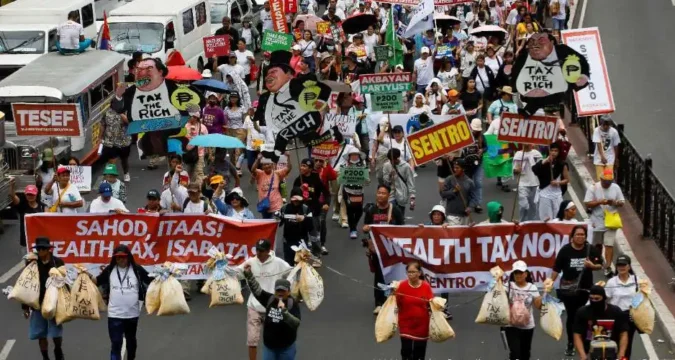
MANILA (LiCAS News): On 1 May, Church and labour groups demanded higher wages, stronger workers’ rights, and immediate policy reforms, warning that Philippine workers face deepening poverty, unsafe workplaces, and repression.
Statements from Church People–Workers Solidarity [CWS], the National Council of Churches in the Philippines [NCCP], and the Centre for Women’s Resources [CWR] highlighted rising living costs, stagnant wages, increasing job insecurity, and mounting labour rights abuses—especially affecting women.
CWS described a “painful truth”: those building the nation are “burdened by deepening poverty, insecurity, and injustice,” and many remain unheard “in their cry for dignity, just wages, and safe working conditions.”
They noted that the Family Living Wage in Metro Manila now stands at 1,266 pesos per day, while the minimum wage is only 695 pesos—a gap they labelled “not merely an economic issue” but “a moral failure.”
CWS warned of deteriorating job quality, with unemployment up to 5.8 per cent and many jobs insecure, contractual, or short-term. “Work that strips dignity, denies stability, and withholds rightful benefits cannot be called just work,” it said.
The group stressed that workplace safety remains poor, with reports of daily worker deaths in 2025 due to preventable accidents. “Every worker’s life is sacred. No profit margin can justify unsafe conditions,” the statement read.
Family Living Wage in Metro Manila now stands at 1,266 pesos per day, while the minimum wage is only 695 pesos
They also denounced repression against labour advocates, citing harassment, arrests, and extrajudicial killings. “To organise is not a crime. To demand just wages is not subversion. To stand for dignity is not rebellion,” it said.
CWS pointed to the energy crisis, which, “exacerbated by global tensions,” is raising food, transport, and goods prices. They criticised the government’s refusal to suspend fuel taxes, calling it “a troubling preference: short-term relief over long-term justice, profit over people.”
NCCP echoed the need for a living wage, stressing that “workers deserve fair compensation—not just any wage, but a living wage that enables them to support and protect their families in a decent home.”
As we celebrate the 500 years of Christianity in the Philippines. The Chaplaincy to Filipino Migrants organises an on-line talk every Tuesday at 9.00pm. You can join us at:
https://www.Facebook.com/CFM-Gifted-to-give-101039001847033
The council noted that higher fuel and basic goods prices strain workers as wages remain stagnant and “incredibly insufficient.” They questioned government actions, noting that transport subsidies have been criticised for being inadequate and ultimately benefiting oil companies.
NCCP called for broader government measures, such as suspending excise taxes on essentials and curbing oil prices, and urged a “more independent, people-centred path” for the economy.
The Centre for Women’s Resources said that women disproportionately face unstable, low-paid, and unprotected work.
Workers in the Philippines face a deteriorating labour landscape marked by meagre wages that barely meet basic needs, persistent job insecurity, intensified labour flexibilisation, and worsening safety and working conditions,
The Centre for Women’s Resources
“Workers in the Philippines face a deteriorating labour landscape marked by meagre wages that barely meet basic needs, persistent job insecurity, intensified labour flexibilisation, and worsening safety and working conditions,” the group said.
They added that labour flexibilisation traps workers in unstable, low-paid jobs with limited benefits and weakens their ability to unionise.
CWR also referenced the Philippines’ ranking among the world’s 10 worst countries for workers in 2025, citing “systematic violation of labour rights, which include red-tagging, threats and intimidation, violent dispersal of strikes, and extrajudicial killings.”
Women from marginalised backgrounds are especially affected, with CWR interviews revealing some “resorting to extreme measures, such as skipping meals and reducing food intake, just to ensure their families survive.”
CWR called for a higher minimum wage of 1,200 pesos, removal of value-added tax and excise duties on essentials, and greater protection of the right to organise.
A society that silences its workers undermines its own foundation,
CWS
“Now more than ever, CWR reaffirms its commitment to working towards a society where every worker is protected, empowered, and valued,” it said, adding that “only through collective struggle can these goals be achieved.”
The various groups urged government, employers, and society to address inequalities and respect the dignity of labour.
“A society that silences its workers undermines its own foundation,” CWS said.of 1,200 pesos, removing value-added tax and excise duties on oil and other essential commodities, and upholding workers’ fundamental right to freedom of association.
“Now more than ever, CWR reaffirms its commitment to working towards a society where every worker is protected, empowered, and valued,” it said, adding that “only through collective struggle can these goals be achieved.”
Across the statements, the groups urged government, employers, and civil society to address structural inequalities and uphold the dignity of labour.
“A society that silences its workers undermines its own foundation,” CWS said.
Related posts:

Papal envoy to meet US president as part of mission to help Ukraine

Parish network was key to quick response, says Caritas Ukraine director

Cardinal Stephen speaks about fire at Wang Fuk Court