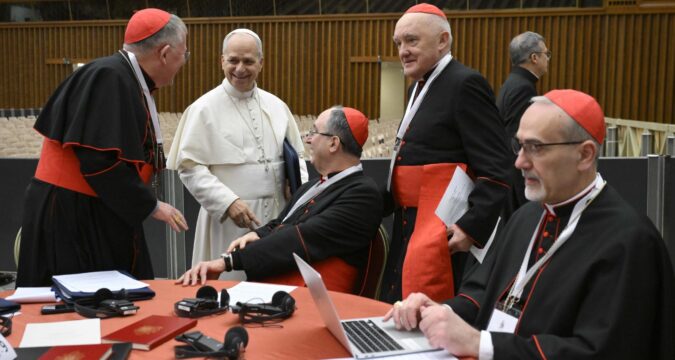
(OSV News): Pope Leo XIV sent a letter to the College of Cardinals thanking them for their participation in the January consistory and preparing the conversation for their next gathering from June 26-27—right before the solemnity of Ss. Peter and Paul.
The January consistory focused on two topics, voted on by the cardinals: synodality and Pope Francis’ apostolic exhortation Evangelii Gaudium [The Joy of the Gospel].
The pope did not specify the topics of the next consistory would be, but gave hints on what the possible further reflections might be, driven by the first consistory that coincided with the closing of the Jubilee Year doors on January 6.
The conversation in January resulted in “free, concrete and spiritually fruitful exchanges,” the pope said in his letter, dated April 12 and published by the Vatican April 14.
“The compiled contributions constitute a resource of lasting value, which I hope will be reflected on further, and will mature through ecclesial discernment,” he said.
Reflecting on “mission and the transmission of the faith” aspects of Evangelii Gaudium, the Pope Leo said in his letter that the exhortation “was recognised as a ‘breath of fresh air,’ capable of initiating processes of pastoral and missionary conversion—rather than producing immediate structural reforms—and thus profoundly guiding the Church’s journey.”
The compiled contributions constitute a resource of lasting value, which I hope will be reflected on further, and will mature through ecclesial discernment
Pope Leo
The pope said, “This journey affects the very quality of spiritual life, expressed in the primacy of prayer, in the witness that precedes words, and in the coherence between faith and life,” adding that at the community level, “it calls for a shift from a pastoral approach of maintenance to one of mission.”
Pope Leo said that communities should be “living agents of the proclamation,” meaning they should be welcoming, using accessible language and being attentive to the “quality of relationships, and capable of offering places for listening, accompaniment and healing.”
He warned that on the diocesan level, the responsibility of pastors “to resolutely support missionary boldness” cannot be “weighed down or stifled by organizational excesses,” but needs to be “guided by a discernment that helps us to recognize what is essential.”
He wrote, “From all this flows a profoundly unified understanding of mission,” defining the mission as “Christ-centred and kerygmatic.”
He said, “It is born of an encounter with Christ that is capable of transforming lives and spreading through attraction rather than conquest,” adding, “It is an integral mission, holding in balance explicit proclamation, witness, commitment and dialogue, and yielding neither to the temptation of proselytism nor to a merely institutional mentality of preservation or expansion.”
This journey affects the very quality of spiritual life, expressed in the primacy of prayer, in the witness that precedes words, and in the coherence between faith and life…it calls for a shift from a pastoral approach of maintenance to one of mission
Pope Leo
Even when the Church finds herself in a minority, the pope said, “she is called to live with confident courage, as a small flock bringing hope to all, mindful that the aim of mission is not its own survival, but the communication of the love with which God loves the world.”
Among the specific suggestions that emerged from the January consistory, the pope pointed to some deserving further reflection, such as “the need to relaunch Evangelii Gaudium through an honest assessment of what has actually been embraced over the years” and what “remains unfamiliar or unimplemented, with particular attention to the necessary reforms of the processes of Christian initiation.”
He also pointed out to “the importance of valuing apostolic and pastoral visits as authentic opportunities for kerygmatic proclamation and for a growth in the quality of relationships” and “the similar need to reassess the effectiveness of ecclesial communication, including at the level of the Holy See, from a more explicitly missionary perspective.”
On the day his letter was released, the pope celebrated the first-ever public papal Mass in Algeria—a country that is 99 per cent Sunni Muslim, home to fewer than 9,000 Catholics among more than 45 million people.