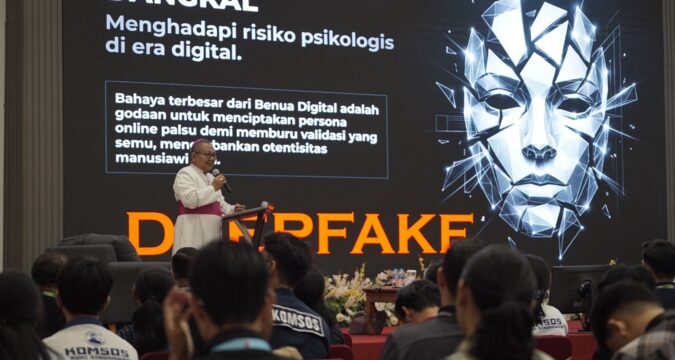
PONTIONAK (LiCAS News): Bishop Agustinus Tri Budi Utomo, chairperson of the Social Communications Commission of the Indonesian Bishops’ Conference [KWI], encouraged Catholic communicators to enter a “space of silence” and reflection amid growing digital noise as they respond to rapid technological change.
Communication technologies, the Internet, and artificial intelligence [AI] have become integral parts of daily life. While the Catholic Church does not reject these developments, Bishop Utomo said technology should be viewed not merely as a technical tool but as a means of presenting God’s loving presence and voice to the world.
Quoting the message of Pope Leo XIV, the bishop of Surabaya said communication should become a channel for proclaiming love, truth, and fraternity.
“Do not merely become users of technology. Technology must present the face of God’s love to the world,” Bishop Utomo said on May 27 during the 13th National Social Communications Celebration in Pontianak, West Kalimantan.
Do not merely become users of technology. Technology must present the face of God’s love to the world,
Bishop Agustinus Tri Budi Utomo
The gathering, hosted by the Archdiocese of Pontianak from May 26 to 31, formed part of the Church’s observance of the 60th World Day of Social Communications and brings together participants from dioceses across Indonesia to discuss faith, ethics, and emerging technologies.
As keynote speaker at a national seminar titled “Grounding the Pope’s Message for the 60th World Day of Social Communications 2026,” Bishop Utomo called on communications workers to protect the human face and voice in an increasingly digital environment.
“Not only should the Church become a safe and sacred space, but our social media spaces must also become safe and holy spaces, not places that provoke hatred. Technological progress must become a pillar for protecting human dignity,” the bishop said.
The Church encourages people to remain authentic without rejecting technology. Catholics, he said, should not accept falsehoods blindly but remain critical when confronted with deepfakes and digital manipulation.
In the same forum, information technology expert, Professor Richardus Eko Indrajit, stressed that AI should remain a tool and never replace human beings.
The human face is an icon of God—it is sacred. Human faces and voices should not be falsified because each person is unique and irreplaceable, unless permission is granted for a good purpose
Richardus Eko Indrajit
AI, he said, should support encounters between people rather than substitute for them.
“The human face is an icon of God—it is sacred. Human faces and voices should not be falsified because each person is unique and irreplaceable, unless permission is granted for a good purpose,” Eko said.
Discussions during the gathering also focused on the impact of digital culture on young people.
Frans Kristi Adi warned about the tendency of young people to seek virality and appear “cool” on social media, often relying on AI to support that image.
“We may appear warm on social media while becoming cold in real life,” he said, reminding participants that AI can never replace the human conscience.
Local influencer F. Deliana Winki encouraged young people to present their authentic selves rather than false realities online.
She said she built her personal identity around the sape’, a traditional Dayak string instrument known as “the voice of the forest” and deeply rooted in Dayak culture.
“Trust in God in every effort. I reached the Vatican because of God’s blessing. Every person is unique,” Delly said.