MANILA (LiCAS News): Bishop Gerardo Alminaza of San Carlos, the Philippines, was among three individual awardees recognised during the 9th Gawad Bayani ng Kalikasan [Environmental Heroes Award] at the Benito Sy Pow Auditorium at the University of the Philippines Diliman on October 24.
Former ACT Teachers Party-list representative, France Castro, and Dr. Ana Marie Rilloraza-Leung were also honoured in the individual category.
The biennial Gawad Bayani ng Kalikasan [GBK] honours Filipino individuals and organisations involved in defending the environment, communities, and people’s rights. The event was co-organised by the Centre for Environmental Concerns-Philippines and IBON Foundation.
Bishop Alminaza, who heads Caritas Philippines, renewed his call for communities affected by development projects to have a voice in decisions that shape their lives and environment.
The bishop said he accepted the recognition in solidarity with environmental defenders and communities who continue their work despite the risks they face.
“Receiving the GBK award was a touching recognition that I accepted in solidarity with all environmental defenders and communities who continue the work, often at great cost,” he said.
Bishop Alminaza said environmental advocates are sometimes criticised for speaking about ecological destruction and questioning development driven by greed.
“As environmental defenders, we are sometimes called doomsdayers or killjoys because we speak about the destruction of the Earth and ask hard questions about greed and development. However, it is my experience that environmental defenders are full of courage, compassion, and hope,” The bishop said.
“We defend the Earth because we love life. We know that we are connected to one another and to the land, water, and other living beings that sustain us,” he added.
As we celebrate the 500 years of Christianity in the Philippines. The Chaplaincy to Filipino Migrants organises an on-line talk every Tuesday at 9.00pm. You can join us at:
https://www.Facebook.com/CFM-Gifted-to-give-101039001847033
Bishop Alminaza said he found it difficult to relate to being called a “Bayani” [hero] and preferred to be known as a “Tagapangalaga ng Kalikasan” [caretaker of creation].
He said his awareness of environmental degradation was shaped in part by growing up in San Jose, Sipalay, on Negros Island, a town shaped in part by copper mining.
The bishop also pointed to recent encounters with indigenous communities in Western Visayas, including the indigenous Ati community in Boracay and others facing displacement as large hotels and businesses advance in the name of development.
“Their situation asks us: Can we call something progress if the people whose homes, land, and lives are affected have little say in what happens to them?” he said.
Bishop Alminaza also cited an initial convening involving communities from six countries connected by the Mekong River.
“Their stories remind us that the river’s health and people’s lives are bound together. Those who depend on the Mekong must have a voice in decisions about its future,” he said.
The said farmers, Indigenous Peoples, fisherfolk, women, young people, and communities affected by harmful projects were among those present at the Gawad Bayani ng Kalikasan gathering.
“The Gawad Bayani ng Kalikasan awards helped emphasise that we need more chairs and tables where people can speak and be heard,” Bishop Alminaza said.
The bishop linked that approach to “Hayuma” [repairing the nets], a Visayan term he uses to describe the work of restoring what has been damaged.
“We mend what is broken together. When people are being harmed, we stand with them, defend their rights, and help stop the harm. Then, we continue the work of mending together—protecting life and the environment, and restoring what displacement and exploitation have torn apart,” he said.
The organisational awardees were the Jalaur River for the People’s Movement, Alyansa ng Novo Vizcayano para sa Kalikasan, and Barikada ng Mamamayan ng Sibuyan.
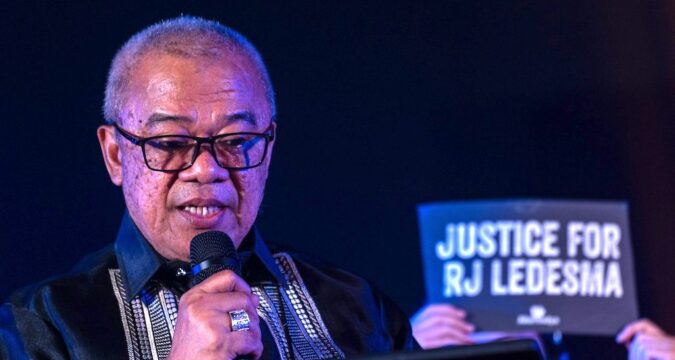
Late community journalist RJ Ledesma was named the most distinguished awardee as he was honoured for his reporting on the struggles of peasants and indigenous communities against large-scale infrastructure projects, land grabbing, and fossil fuel projects.
Bishop Alminaza and Altermidya Network chairperson, Raymund Villanueva, received the award on Ledesma’s behalf.
The bishop celebrated RJ Ledesma’s life and legacy. He called Ledesma both a “Bagani” [hero] and “Hakson” [to embrace], noting that ‘Hakson’ was also the name of Ledesma’s youth-led environmental group fighting land grabbing and ecological harm on Negros Island.
He praised Ledesma’s journalism for spotlighting the struggles of the poor and the environment, and for inspiring solidarity and compassion. Ledesma, killed in Toboso, Negros Occidental, was remembered as a champion for ecological and agrarian justice, whose legacy continues to unite and inspire others.