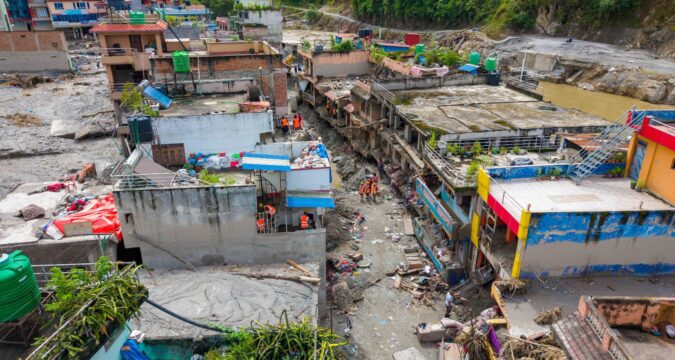
(LiCAS News): Religious leaders from different faith traditions across the Asia-Pacific joined in an online prayer service. They called for stronger action on climate justice following devastating floods and landslides in Nepal’s Himalayan region.
The interfaith online prayer, titled “With Nepal: A Prayer of Solidarity, Healing and Hope”, was held on September 15 and brought together Catholics, Muslims, Buddhists, members of the Bahá’í faith, and representatives of Nepal’s Indigenous Kirat spiritual tradition.
Organised by the Laudato Si’ Movement, the Federation of Asian Bishops’ Conferences–Office of Human Development [FABC-OHD] and Radio Veritas Asia, the event gathered religious leaders, environmental activists and civil society representatives from Indonesia, Myanmar, South Korea, the Philippines, Timor-Leste and Nepal.
The gathering followed devastating floods and landslides that struck the Nepal-Tibet Himalayan region on August 26. The disaster damaged infrastructure, disrupted transport and economic links, and caused deaths and disappearances in Nepal and in downstream areas of India.
Religious leaders said the tragedy also pointed to a deeper ecological crisis affecting the Himalayan region, known as the world’s “Third Pole” because it contains the largest concentration of ice outside the Arctic and Antarctic.
Religious leaders said the tragedy also pointed to a deeper ecological crisis affecting the Himalayan region
Himalayan crisis
The Hindu Kush Himalaya region is experiencing rapid environmental changes, including glacier retreat, melting permafrost, and increasing geological instability. These changes increase the risk of cascading disasters, such as glacial lake outburst floods and landslides.
The region is also crucial to Asia’s water security. Himalayan glaciers feed major river systems on which more than two billion people depend for water, agriculture, and food security.
The disaster raises questions of climate justice, organisers said, because vulnerable mountain communities contribute relatively little to global carbon emissions while facing severe consequences from a changing climate.
Prayer across faith traditions
During the online prayer gathering, participants from different religious traditions expressed solidarity with victims and survivors.
Representing the Muslim community in Indonesia, Swary Utami Dewi recited the Al-Fatihah and prayed for protection for those affected by the disaster, strength for grieving families, and safety for humanitarian workers.
We are called not only to give sympathy, but to take concrete prophetic action
Bishop Allwyn D’Silva
Desytia Nawris of the Bahá’í International Community offered a prayer asking God to protect people facing suffering and disaster.
Venerable Ashin Nandasara, representing Theravada Buddhism from Myanmar, invoked the blessings of the Buddha, Dhamma and Sangha for all beings, praying that they might live in peace and be freed from suffering.
Nepali spiritual leader, Nabin Lingden, from the Indigenous Kirat tradition, offered a prayer invoking the Creator of the sky, wind, fire, water, and earth. He prayed for the protection of people and nature from earthquakes, floods, and landslides, and remembered those who died in the disaster.
The prayers differed in language and religious tradition, but shared a common concern for people suffering and the vulnerability of the natural world.
‘Not only sympathy’
For the Catholic Church, the disaster is also a call to ecological conversion.
Bishop Allwyn D’Silva, chairperson of the FABC Office of Human Development and emeritus bishop of Mumbai, linked the tragedy to the Catholic Church’s observance of the Season of Creation.
The floods, he said, should serve as a reminder that humanity has pushed nature beyond its limits.
The prayers differed in language and religious tradition, but shared a common concern for people suffering and the vulnerability of the natural world
“We are called not only to give sympathy, but to take concrete prophetic action”, said Bishop D’Silva, referring to the need for renewable energy, greater energy efficiency, and serious reductions in carbon emissions.
Lilik Krismantoro of the Laudato Si’ Movement Indonesia echoed the appeal. “Ecological destruction knows no administrative borders”, said Lilik.
“What affects the peaks of the Himalayas today directly affects climate stability and ecosystems throughout Asia”, he added.
“Our solidarity must not stop at prayer, but must be translated into transformation of lifestyles and advocacy for just climate policies”, Lilik urged.
From prayer to action
The interfaith gathering called for action in three areas:
Governments in Asia were urged to strengthen cross-border co-operation in glacier monitoring, and to develop early-warning systems involving local communities.
What affects the peaks of the Himalayas today directly affects climate stability and ecosystems throughout Asia
Lilik Krismantoro
Countries with high carbon emissions and policymakers were also urged to accelerate the transition away from fossil fuels towards renewable energy.
Post-disaster assistance, the gathering said, should go beyond rebuilding physical infrastructure and address the long-term social, economic and psychological recovery of affected communities.
Organisers said the prayer gathering was intended not simply as an expression of grief, but as a shared moral response to the ecological crisis.
They stressed that the Himalayan disaster showed how closely communities across Asia are interconnected.
For the participants, solidarity across religious traditions meant prayer for those who suffer, protection for vulnerable communities, and concrete action to care for the Earth.