MANILA (LiCAS News): Cartias Philippines said that the energy agenda of the country’s president, Ferdinand Marcos Jr., cannot solve the country’s power crisis without confronting climate change, reducing dependence on imported fossil fuels, and overhauling the law governing the electricity sector.
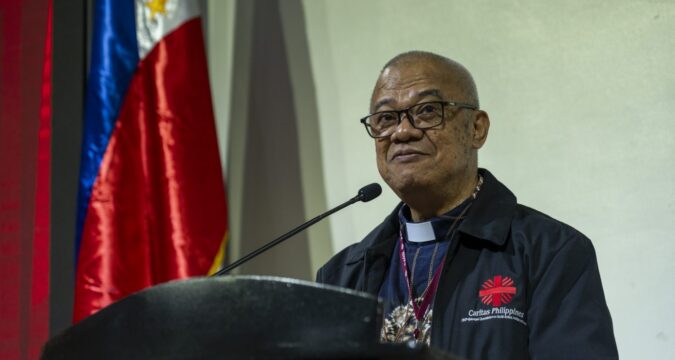
Commenting on fifth State of the Nation Address [SONA], Bishop Gerardo Alminaza of San Carlos, president of Caritas Philippines, said “The environment must no longer be the empty chair at our national table. Caring for creation is not a peripheral concern. It is inseparable from protecting life, securing justice, and building a future worthy of every Filipino.”
In his address Marcos did not address the climate crisis, destructive mining, or communities threatened by the continued expansion of fossil fuel infrastructure, Bishop Alminaza said.
The bishop said in his July 30 statement that omission came as Filipino families faced some of the highest electricity rates in Southeast Asia while enduring stronger storms, floods, droughts, and the loss of farms, fishing grounds, and livelihoods.
“For millions of Filipinos, the environmental crisis is no longer merely ecological. It is economic, social, and deeply human,” he said.
For millions of Filipinos, the environmental crisis is no longer merely ecological. It is economic, social, and deeply human
Bishop Alminaza
While Bishop Alminaza welcomed Marcos’ call to remove system loss charges from electricity bills, saying consumers should not be made to pay for losses they did not cause, he said the proposal addressed only part of the country’s energy crisis.
“This is a demand they [public] have raised for decades. It cannot be presented as a sufficient response to the energy crisis,” the bishop said adding that heavier burden on consumers comes from high generation costs and the country’s dependence on imported coal and gas.
Under the Electric Power Industry Reform Act, or EPIRA, these costs are passed on to consumers while power companies are shielded from fuel price increases and supply disruptions, according to Bishop Alminaza.
“EPIRA must not be amended only to remove systems loss charges. The entire policy and regulatory framework governing electricity needs to be overhauled,” he added.
As we celebrate the 500 years of Christianity in the Philippines. The Chaplaincy to Filipino Migrants organises an on-line talk every Tuesday at 9.00pm. You can join us at:
https://www.Facebook.com/CFM-Gifted-to-give-101039001847033
The bishop said the law had failed to deliver affordable and reliable power after 25 years and had increasingly treated electricity “as a commodity for private profit rather than as an essential public service and a common good.”
Fossil gas is not clean energy
Bishop Alminaza
However, he welcomed the president’s support for easier access to rooftop solar and battery storage. He said the proposed “Sariling Kuryente” [one’s own electricity] Act could help families and communities produce their own electricity, particularly during disasters and power interruptions.
“This is where public investment, regulatory reform, and political leadership should be directed,” he said.
However, Bishop Alminaza warned that the initiative would lose its meaning if the administration continued to promote dirty energy sources, expand fossil gas infrastructure, and revive nuclear power.
“Fossil gas is not clean energy,” he stressed.
More gas terminals and power plants would deepen dependence on imported fuel, expose consumers to unstable prices, and lock the country into decades of fossil fuel use, the bishop explained said.
He also rejected nuclear power as a practical response to the electricity crisis, citing its cost and concerns over safety, radioactive waste, public debt, and accountability.
The transition to clean energy cannot become an excuse for sacrificing ancestral domains, forests, watersheds, farms, fishing grounds, and community rights through destructive mining and mineral extraction
Bishop Alminaza
Public concerns “should not be dismissed as mere misunderstanding,” he said, adding that they require transparent, independent and participatory scrutiny because the risks, costs and long-term consequences will affect generations to come.
Bishop Alminaza also warned that renewable energy projects should not be considered just or sustainable simply because they carry the renewable label. Such projects must not destroy forests, watersheds, and biodiversity; displace indigenous peoples, farmers, fisherfolk, and other communities; or place the country’s energy future under the control of a few large corporation.
“The transition to clean energy cannot become an excuse for sacrificing ancestral domains, forests, watersheds, farms, fishing grounds, and community rights through destructive mining and mineral extraction,” he said.
The bishop said environmental protection could not be separated from the struggle against poverty.
“For Caritas, care for creation is never separate from care for the poor. The ecological crisis and the crisis of poverty are one human crisis that demands an integral response,” he said.
“The environment must no longer be the empty chair at our national table. Caring for creation is not a peripheral concern. It is inseparable from protecting life, securing justice, and building a future worthy of every Filipino,” he added.