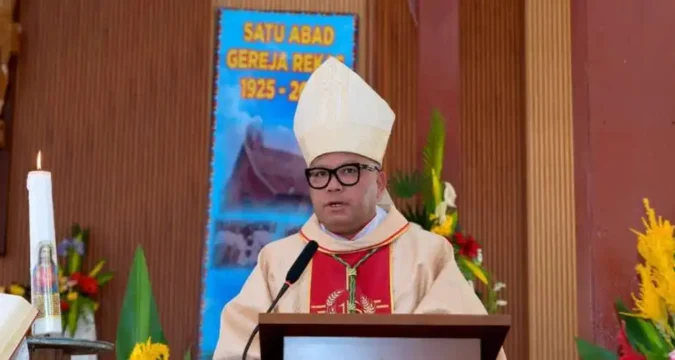
FLORES (UCAN): The Diocese of Labuan Bajo, located on Flores Island, Indonesia, declined to participate in a dialogue on geothermal energy organised by Catholic universities, while urging the universities to uphold their moral responsibility. The multi-stakeholder forum was scheduled for July 23 at the Ledalero Institute of Philosophy and Creative Technology [IFTK Ledalero], in Maumere, Sikka Regency, and included Church institutions, government representatives, and project developers.
“We appreciate the concern and efforts of the organising institutions. However, the Diocese of Labuan Bajo has decided not to attend the forum or send a representative,” said Bishop Maksimus Regus in a statement on July 19.
Bishop Regus explained that the decision was not a rejection of dialogue, science, or development, but rather “a form of moral and pastoral consistency” in defending communities, protecting creation, and ensuring that development serves both people and the environment.
A dozen indigenous communities across Flores and Lembata islands have already rejected public dialogue on Indonesia’s Flores geothermal plan.
Alongside IFTK Ledalero, the organisers included Parahyangan Catholic University in Bandung and the Indonesian Catholic University of St Paul in Ruteng, where Bishop Regus had previously served as rector before becoming bishop.
“Academic autonomy must be respected, but Catholic identity also carries a moral responsibility to side with life, vulnerable communities and environmental sustainability,” the bishop reminded the organisers.
Flores was designated a geothermal island by Indonesia’s Energy and Mineral Resources Ministry in 2017—a move resisted by local communities and Church groups.
Of the more than 20 designated working areas, with an estimated geothermal potential of 776–902 megawatts, only three power plants are currently operating, with a combined capacity of approximately 20.5 megawatts.
One project site is located in Wae Sano, within the Diocese of Labuan Bajo, which Bishop Regus has opposed in a pastoral letter.
The bishop referenced the 2025 Lenten pastoral letter from the bishops of the Ende Ecclesiastical Province, which opposed geothermal development and called for exploitation plans to be halted, ongoing sites to be evaluated, and an exit strategy to be prepared.
Bishop Regus also warned that public dialogue could amount to “asymmetrical participation” when parties are in the same room but lack equal power to set the agenda, influence decisions, or shape outcomes.A civil society network of 76 groups, including Church groups, also formally rejected the forum and the use of terms such as energy transition and green energy to justify geothermal projects.
In a July 20 statement, the network urged religious institutions, universities, civil society groups, academics and media outlets not to legitimise the projects.
Melky Nahar of the Mining Advocacy Network said the forum presented geothermal projects as energy independence, clean energy, and a just transition, while treating residents’ objections as technical issues instead of recognising them as legitimate concerns for their land, water, and living space.
Divine Word Father Otto Gusti Madung, rector of IFTK Ledalero, stated that his campus’s moral and institutional stance had not changed. “It continues to reject geothermal projects in Flores, while supporting affected communities,” he emphasised.
However, he affirmed that the institute remains open to dialogue and critical examination of public policy as a higher education institution, while emphasising that openness does not equate to neutrality in the face of injustice.