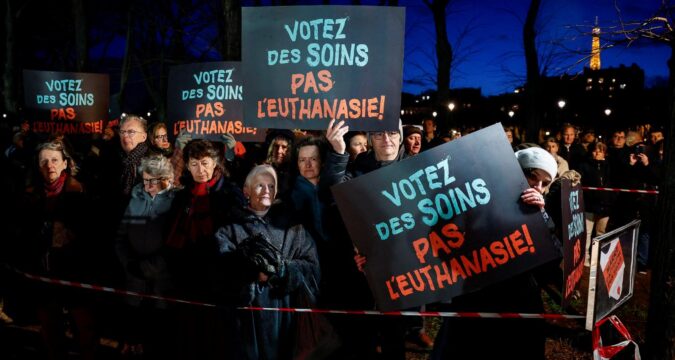
PARIS (OSV News): The bishops of France criticised a watershed vote by the National Assembly on July 15 legalising assisted dying, including euthanasia and assisted suicide in certain cases with 291 members of the National Assembly votingh in favour, 241 against, and 29 absentees.
Jean-Marc Cardinal Aveline of Marseille, president of the French Bishops’ Conference, lamented that “members of parliament have enshrined in French law the possibility of causing death.”
He said on behalf of the bishops, “This choice breaks with the long tradition of care whose purpose is to alleviate suffering and accompany each person to the natural end of their life.”
The bishops’ statement, signed by Archbishop Vincent Jordy of Tours and Bishop Benoît Bertrand of Pontoise, deputy presidents of the French bishops’ conference, called on Catholic healthcare institutions to “refraining from behaviour that is clearly morally reprehensible, in accordance with the dignity of all human life.”
For the French bishops, “July 15, 2026, marks a serious turning point in the history of our country.”
A question so fundamental to our social contract deserved that the human, medical, ethical, and social consequences of euthanasia and assisted suicide be fully considered
French Bishops’ Conference
This is the fourth time since May 2025 that French deputies have voted in favour of the bill legalising “assisted dying.” Senators have overwhelmingly rejected it on three occasions, and the percentage of deputies supporting the bill has dropped significantly since the first vote, but the decline was not sufficient to stop the bill from passing.
The law authorises assisted dying and, in certain cases, allows a doctor or nurse to administer the lethal substance themselves, making euthanasia legal in France. The legislation now faces review by France’s Constitutional Council before it can take effect.
The French bishops openly lamented that the country’s president, Emmanuel Macron, had arbitrarily sided with the National Assembly’s decision, despite the numerous controversies surrounding this bill.
“A question so fundamental to our social contract deserved that the human, medical, ethical, and social consequences of euthanasia and assisted suicide be fully considered,” the bishops said.
The law authorises assisted dying and, in certain cases, allows a doctor or nurse to administer the lethal substance themselves, making euthanasia legal in France
“Experience in other countries shows that the criteria for access to assisted dying always tend to broaden, to the detriment of palliative care,” they noted.
Meanwhile, “the effects of such legislation are not yet fully measured, but they are already taking shape,” the bishops warned. “Our relationship to vulnerability, old age, disability, and illness will change,” they added.
“The poorest are likely to be the first to pay the price: not wanting to be a burden on their children or grandchildren, elderly people in precarious situations may feel pressured to die,” the bishops warned.
The most immediate and concrete concern is that, if the law goes into effect, care facilities—foremost among them Catholic institutions—could face legal action if they refuse to allow euthanasia or assisted suicide to take place on their premises. As it stands, the law will require the head of the facility or department to authorise outside practitioners to perform the lethal procedure.
The bishops of France have reiterated their call to Catholics in France to “bear witness that another path is possible—one of faithful presence and attentive care that alleviates physical or psychological suffering, without ever abandoning anyone.”