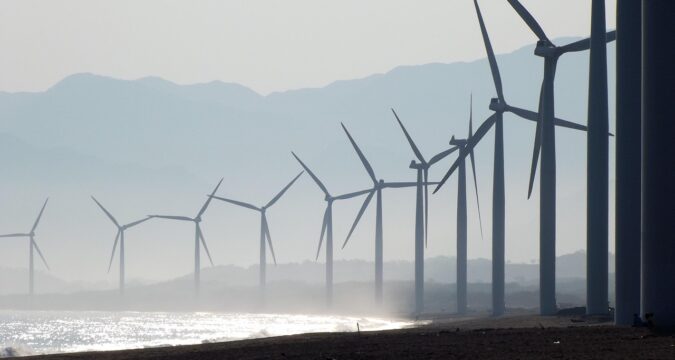
LAOAG (LiCAS News): Bishop Renato P. Mayugba of the Diocese of Laoag, urged Philippine authorities to protect coastal fishing communities from the impact of a proposed offshore wind project in Ilocos Norte and said the country’s transition to renewable energy must not come at the expense of the poor.
In a circular issued on June 28, said the diocese’s position followed months of consultations, prayer, and discernment with coastal residents in Burgos, Bangui, and Pagudpud.
The circular concerns the proposed BuhaWind Offshore Windfarm, a 360 billion peso joint venture between Danish renewable energy firm Copenhagen Energy A/S and PetroGreen Energy Corp.
According to The Northern Dispatch, the project is expected to generate 2,000 megawatts of electricity and begin operations by 2028 in the coastal waters of Burgos, Bangui, and Pagudpud.
Cresente Garcia, mayor of Burgos, has questioned the project’s offshore location because of its potential impact on coastal livelihoods while saying he is not opposed to renewable energy.
The ecumenical coalition Simbaan ti Ilocos Norte Agkaykaysa a Gimong [united assembly of Churches of Ilocos] has also backed communities opposing the project.
Cresente Garcia, mayor of Burgos, has questioned the project’s offshore location because of its potential impact on coastal livelihoods while saying he is not opposed to renewable energy
“We, the clergy, religious, and faithful of the Diocese of Laoag, guided by the teachings of Laudato Si’, issue this manifestation regarding the proposed massive offshore wind farm projects spanning the coastal waters of Burgos, Bangui and Pagudpud,” the circular said.
The diocese said it undertook “a thorough process of listening to the cry of the people—specifically the small-scale fisherfolk and coastal residents whose livelihoods are deeply intertwined with the sea.”
It said those consultations raised concerns that the project could disrupt traditional fishing grounds, restrict access to coastal waters, and damage marine ecosystems that sustain local communities.
As we celebrate the 500 years of Christianity in the Philippines. The Chaplaincy to Filipino Migrants organises an on-line talk every Tuesday at 9.00pm. You can join us at:
https://www.Facebook.com/CFM-Gifted-to-give-101039001847033
“While we acknowledge the global push for clean and renewable energy, true ecological conversion demands that the pursuit of green energy must not come at the expense of the poor and the destruction of our local environment,” the circular said.
“Our stance is not born of mere opposition to progress, but from a profound moral duty to protect human dignity and the integrity of creation. We must hear both the cry of the earth and the cry of the poor,” it added.
The circular said more than 6,500 municipal fisherfolk in Pasuquin, Burgos, Bangui, and Pagudpud face “immediate economic displacement” if permanent 50-metre no-sail zones are established around the proposed turbines.
While we acknowledge the global push for clean and renewable energy, true ecological conversion demands that the pursuit of green energy must not come at the expense of the poor and the destruction of our local environment
Diocese of Laoag
It also warned that underwater foundations could permanently disrupt marine habitats in Bangui Bay and that continuous low-frequency underwater noise could affect biodiversity and fish migration.
“The winds and seas of the north are the sacred heritage of the Ilocano people, not commodities for corporate exploitation,” the circular said.
“We oppose the creeping industrialisation of our historic shorelines by commercial developers. This project threatens to turn shared, cultural maritime spaces into restricted, privatised corporate zones,” it added.
The diocese linked environmental degradation with social injustice, saying “the social and environmental crises are deeply interconnected” and that “the poor bear the worst consequences of reckless development.”
It added that “development cannot be built on the backs of marginalised coastal communities for the benefit of distant investors” and warned against “the destruction of God’s creation under the banner of renewable energy.”
The diocese called on government officials, scientists, academics, young people, and civil society groups to protect the province’s coastal waters and prioritise “genuine human ecology over corporate greed.”
The diocese said, “Let it be known to the developers, the investors, and the authorities: the land, the wind, and the seas of Ilocos Norte are not for sale. They are a sacred trust, passed down by our ancestors, sustained by our laborers, and protected by the Almighty.”
Related posts:

Catholic and Anglican faithful share Passover meal in Kowloon City

Women and parish councils important in promoting synodality says Bishop Ha
In a time of war relics of St. Thérèse of Lisieux tours Lebanon