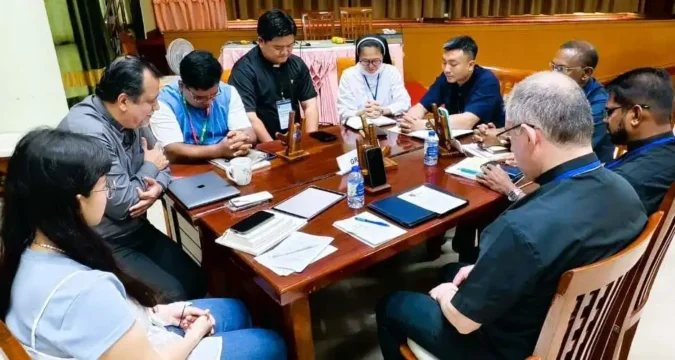
BANGKOK (UCAN): Churches in Asia should prioritise the mission to support Christian families to overcome various challenges with a long-term plan of action for better pastoral care for a more participatory and synodal Church, speakers said during the Synodal Assembly on Family organised by the Office for Laity and Family [OLF] of the Federation of Asian Bishops’ Conferences [FABC], held in Bangkok, Thailand.
Themed “The Mission and Future Roadmap of the Christian Family in Asia Today,” the May 11-15 gathering drew 52 participants from 11 countries at Bangkok’s Camillian Pastoral Centre. They included two cardinals, nine bishops, 16 priests, four nuns and laypeople.
The speakers said that Asian Churches cannot achieve synodality without addressing the existing challenges and developing future action plans for family ministries across various countries and bishops’ conferences.
The speakers said that Asian Churches cannot achieve synodality without addressing the existing challenges and developing future action plans for family ministries across various countries and bishops’ conferences
The seminar focused on the mission and responsibilities of the Christian family within the context of contemporary Asian society and the Church in line with Pope Francis’ post-synodal apostolic exhortation, Amoris Laetitia [The Joy of Love], by addressing the pastoral care of families published in 2016.
FABC-OLF chairperson and Bishop Emmanuel Kanon Rozario from Bangladesh said during the inaugural programme that the core focus of the assembly is “to elevate the dignity and leadership of women in the Church and society.”
He said the Church sees young people “not merely as the future of the Church, but its vibrant present.” Hence, the Church must act as a companion through the complexities of their lives, he noted.
The bishop also called for shaping families as “a living home or nest for the Word of God,” and emphasised finding the future path of the Church through active listening and spiritual discernment via conversation in the Spirit.
Bishop Rozario also noted that empowering families, including the laity, women, and youth, forms part of the Asian Churches’ priorities set out in the “Bangkok Document”—a compilation of discussions held during the FABC general conference in October 2022.
Leading Asian theologian, Father Vimal Tirimanna from Sri Lanka, was a keynote speaker who presented insights on Pope Francis’ Amoris Laetitia and Pope St. John Paul II’s 1981 post-synodal apostolic exhortation Familiaris consortio [On the Role of the Christian Family in the Modern World].
…[the Church sees young people] not merely as the future of the Church, but its vibrant present
Bishop Emmanuel Kanon Rozario
Father Tirimanna emphasised caring for mixed faith families.
In Asia’s multi-religious society, Churches need to view mixed-faith families through the lens of Amoris Laetitia as “living bridges of social and religious harmony”—acting as Basic Human Communities [BHC], he said.
FABC vice president, Pablo Virgilio Cardinal David said evangelisation in Asia depends on understanding the Scriptures and providing strong pastoral care for families.
“The future of evangelisation in Asia depends much more on the regular reading of the Word of God and prayer within the family than on any grand institutional programmes,” he said in his speech.
Cardinal David presented a three-phased spiritual and organisational synodal journey.
The future of evangelisation in Asia depends much more on the regular reading of the Word of God and prayer within the family than on any grand institutional programmes
Pablo Virgilio Cardinal David
In the first phase, he said, the faithful or the People of God spontaneously express their opinions and convictions of faith. In the second, Church leaders [bishops and clergy] reflect and discern those expressions under the light of the Holy Spirit.
The third phase is most crucial and challenging, Cardinal David said. “It’s moving beyond mere words and reviews to actively transform and change our practical lifestyle and pastoral services.”
During the gathering, the participants joined group discussions and presented synthesis reports for a roadmap for the future action plans for families in line with the Bangkok Document.