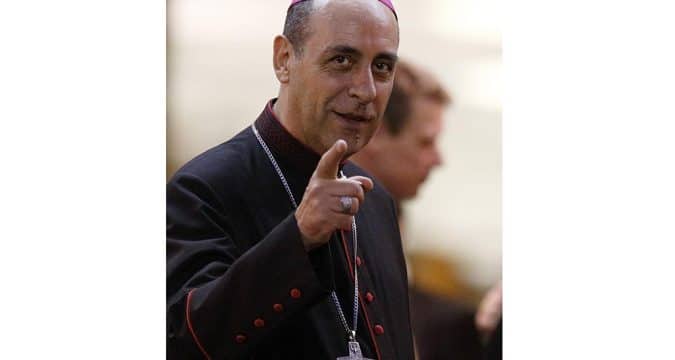
VATICAN (CNS): Pope Francis appointed his longtime theological adviser and fellow Argentinian, Archbishop Víctor Manuel Fernández of La Plata, to lead the Dicastery for the Doctrine of the Faith, urging him in a public letter to expand the office’s focus beyond its reputation as a watchdog pursuing possible doctrinal errors and to promote the understanding and transmission of the faith, the Vatican announced on July 1.
Archbishop Fernández, who turns 61 on July 18, succeeds Luis Cardinal Ladaria, who is 79-years-old and has completed his term as prefect which began on 1 July 2017, according to the Vatican.
Archbishop Fernández will begin his new role mid-September, which also includes serving as president of the Pontifical Biblical Commission and president of the International Theological Commission.
In an open letter to the archbishop, the pope asked him to lead the dicastery toward promoting theology that is attentive to the essentials of the faith and at the service of evangelisation. “Its central purpose is to guard the teaching that flows from the faith in order ‘to give reasons for our hope, but not as an enemy who critiques and condemns.’”
Pope Francis wrote, “The dicastery which you will preside over in other times came to use immoral methods. Those were times when, rather than promoting theological knowledge, possible doctrinal errors were pursued. What I expect from you is certainly something very different.”
Its central purpose is to guard the teaching that flows from the faith in order ‘to give reasons for our hope, but not as an enemy who critiques and condemns’
Pope Francis
The pope recalled the restructuring of the dicastery in 2022 which split the office into two sections: one to handle doctrinal questions and another dedicated to handling disciplinary matters including those related to the abuse of minors.
Given that the specific section for disciplinary matters is staffed “with very competent professionals, I ask you as prefect to dedicate your personal commitment in the most direct way to the principal aim of the dicastery which is keeping the faith,” he wrote.
The pope wrote that the task consists of “increasing the understanding and transmission” of the Catholic faith, especially before questions “posed by the progress of the sciences and the development of society.”
He wrote, “These issues, incorporated in a renewed proclamation of the gospel message, ‘become tools of evangelisation’” because they allow the faith to enter into conversation with “our present situation, which is in many ways unprecedented in the history of humanity.”
The Church, Pope Francis wrote, must “grow in her interpretation of the revealed word and in her understanding of truth.”
The pope wrote, “For differing currents of thought in philosophy, theology and pastoral practice, if open to being reconciled by the Spirit in respect and love, can enable the Church to grow. This harmonious growth will preserve Christian doctrine more effectively than any control mechanism.”
In a July 1 Facebook post, Archbishop Fernández said he accepted the nomination “with much joy” even though there would be many people against him. “There are people who prefer a more rigid, structured way of thinking at war with the world,” he wrote.
For differing currents of thought in philosophy, theology and pastoral practice, if open to being reconciled by the Spirit in respect and love, can enable the Church to grow. This harmonious growth will preserve Christian doctrine more effectively than any control mechanism
The pope told him that while the dicastery was once dedicated to pursuing heretics in the past, he wanted something very different for its future since “errors are not corrected by going after them or controlling them, but by making faith and wisdom grow. This is the best way to preserve doctrine,” the archbishop wrote.
He added that Pope Francis assured him that matters related to abuse pertained to an autonomous section within the dicastery and that, as prefect, he would be tasked with “encouraging the reflection of the faith, deepening theology, promoting a way of thinking that knows how to dialogue with how people live,” and “encouraging free, creative, deep Christian thought.”
When he was archbishop of Buenos Aires, Jorge Cardinal Bergoglio [Pope Francis] nominated then-Father Fernández to become rector of the Pontifical Catholic University of Argentina in 2009. The two have long enjoyed a close relationship, and thepope promptly named him an archbishop after his election to the papacy in 2013.
Archbishop Fernández studied theology with a specialisation in biblical studies at Rome’s Pontifical Gregorian University and obtained a doctorate from the Pontifical Catholic University of Argentina. Since 2017 he has been the president of the doctrine commission of the Bishops’ Conference of Argentina. Between books and academic articles, he has more than 300 publications under his name.
At the Vatican, the archbishop was a member of the drafting committees for the final documents of the 2014 and 2015 Synods of Bishops and he has been credited for contributing to several significant texts of Pope Francis’ pontificate.
In his letter, Pope Francis said that the Church needs “a way of thinking which can convincingly present a God who loves, who forgives, who saves, who liberates, who promotes people and calls them to fraternal service.”
This occurs, the pope said, if “the message concentrates on the essentials, on what is most beautiful, most grand, most appealing and at the same time most necessary.”
“There is a harmonious order among the truths of our message and the greatest danger occurs when secondary issues end up overshadowing the central ones,” he wrote.