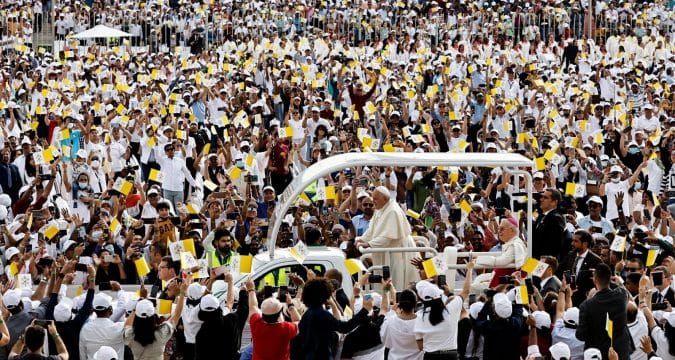
THE PAPAL FLIGHT FROM BAHRAIN (CNS): On the last day of his November 3 to 6 visit to Bahrain, in the Persian Gulf, Pope Francis encouraged the Catholic faithful from around the region to be guardians and builders of unity, reaching out to dialogue with others and living as brothers and sisters.
The pope exhorted them to be prophetic, attentive “interpreters of reality, capable of perceiving God’s presence amid the frequently obscure course of history and making it known to the people.”
He noted that “the words of the prophets are often scathing: they call by name the evil designs lurking in the hearts of the people; they call into question false human and religious certainties, and they invite everyone to conversion,” the pope said.
As he did throughout his visit, Pope Francis emphasised the importance of the unity of Bahrain’s diverse Catholic community, made up mostly of foreign workers.
“I know that you are already offering a good example of walking this path, but fraternity and communion are gifts that we must never tire of imploring from the Spirit,” he said. “In this way, we can fend off the enemy who always sows weeds.”
…the words of the prophets are often scathing: they call by name the evil designs lurking in the hearts of the people; they call into question false human and religious certainties, and they invite everyone to conversion
Pope Francis
On the last stop of his four-day journey, Pope Francis visited the Sacred Heart Church, which was consecrated in 1939 and was the first church built in a Gulf nation. Those gathered represented about 60 priests and two million Catholics spread across four countries: Kuwait, Qatar, Saudi Arabia and Bahrain, as well as Lebanon and other Middle Eastern countries.
In Bahrain, like other Muslim-majority countries, the weekend is Friday and Saturday; Sunday is the start of the work week, so Pope Francis celebrated his main public Mass on November 5 and led a prayer service and the recitation of the Angelus with a smaller group in the Manama church the following day.
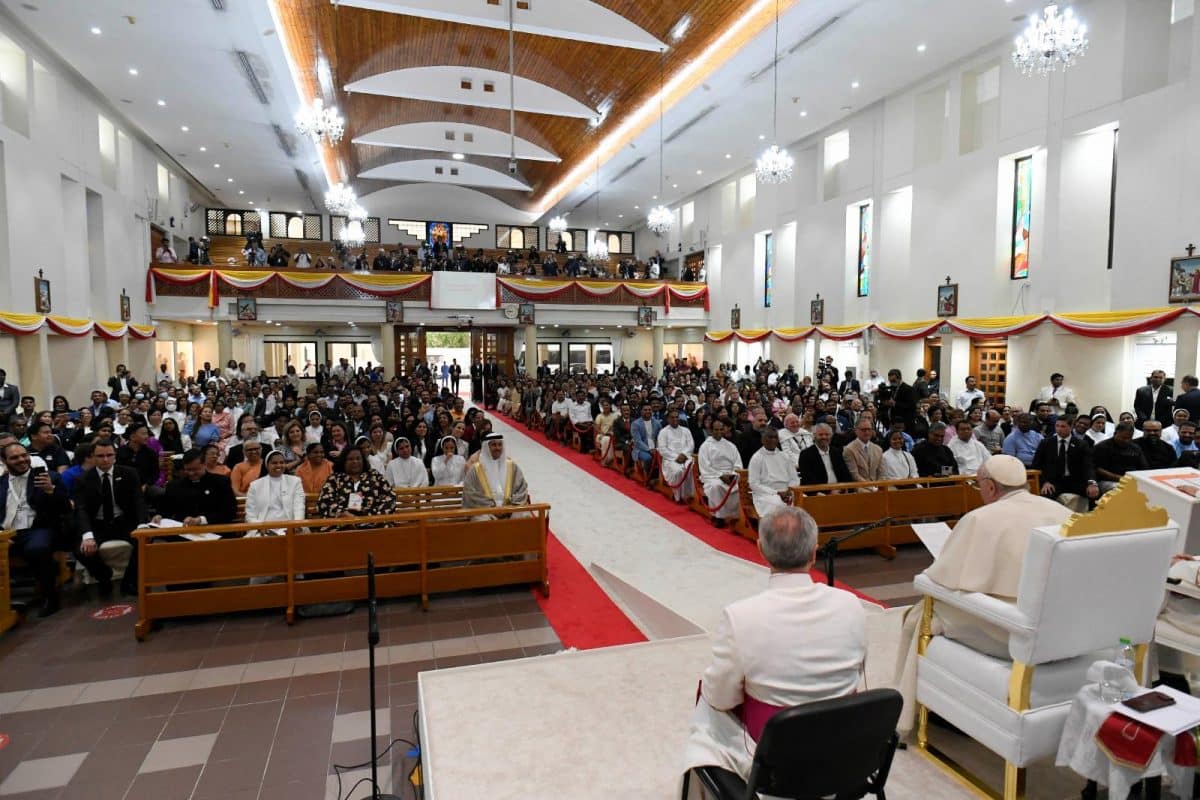
Bishop Paul Hinder, administrator of the Apostolic Vicariate of Northern Arabia, told the pope about the joyful yet also difficult life of a “migrant Church.” Coming from many different countries and ethnicities, “many are struggling daily, but they do so with deep faith,” trusting in the Lord.
The 1,300 catechists throughout the region all work as volunteers, “sometimes under very difficult conditions because of the restrictions in some countries regarding religious freedom, work permits and residency permits,” Bishop Hinder said.
However, they are also deeply aware of God’s presence with them and are “grateful for several positive experiences and encounters in unexpected places,” he said.
Let us seek to be guardians and builders of unity. In order to be credible when we dialogue with others, let us live in fraternity among ourselves
Pope Francis
Pope Francis said the Holy Spirit offers Christians the joy of being with God, “knowing that despite the struggles and dark nights that we sometimes endure, we are not alone, lost or defeated, because he is with us.”
Pope Francis said. “Let us seek to be guardians and builders of unity. In order to be credible when we dialogue with others, let us live in fraternity among ourselves.”
On the flight at the end of the trip, Pope Francis told reporters, “Women are a gift.” After God made man, he didn’t create “a lapdog for him to play with. No, he created two who are equal, a man and a woman.” The pope said that a society that does not give women the same rights and opportunities as men will become impoverished.
“All the rights of women stem from this equality,” he said, and a society that is not able to make room for women “does not move forward.”
The aim of the trip, he said, had been to experience moments of encounter and dialogue, with Muslims, Christians and Catholics. The majority of all residents are foreigners from many different countries, cultures and religions.
The pope said that a society that does not give women the same rights and opportunities as men will become impoverished
As a result of these moments of encounter and talks, he said, he learned something new, that this small nation boasts “a culture open to everyone” with “room for everyone,” including women, who, for example, all have the right to work.
The pope was then asked about the protests in Iran he said, “The fight for rights for women is an ongoing battle because, in some places, women have achieved rights equal to men” and, elsewhere, they lag behind.
It was also not that long ago, he added, that women had to fight for the right to vote in his home country of Argentina, and women in the United States also had to battle for their right to vote. “But why, I ask, do women have to fight like this to keep her rights?” he said.
Another violation that must be stopped, he said, is female genital mutilation. “How is it that in the world today we cannot stop” this practice? “It is a crime, a criminal act.”
Pope Francis asked, “Are women objects to use and throwaway? This is terrible, right? Or are they a protected species?”
Instead it is a question of equality, which still has not been universally achieved, he said. Unfortunately, in some places, women are still considered and treated as “second-class” citizens or worse, and “we have to keep fighting this.”
Women are not inferior, “they are complementary,” he said, and this also means women should be bringing their own unique gifts and talent and must not try to be like men.
“A society that erases women from public life is a society that becomes impoverished,” he said.
“Equal rights, yes, also equal opportunities, equality in moving forward,” he said, adding that there is still a long way to go because there is so much chauvinism, which “kills humanity.”