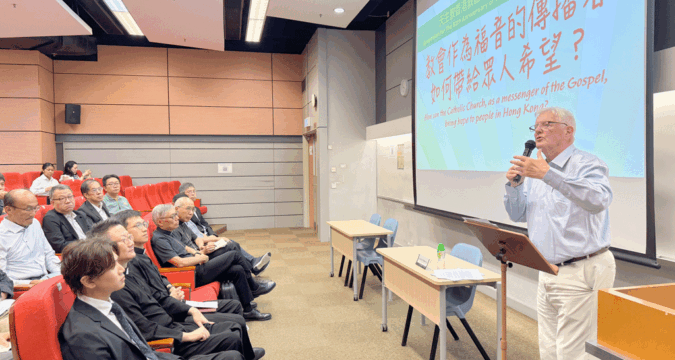
HONG KONG (SE): At the Catholic Diocese of Hong Kong’s 80th-anniversary symposium at Saint Francis University on September 11, Irish Jesuit theologian Father Gerry O’Hanlon outlined key perspectives for local Church renewal. He said communal discernment must pair honest dialogue and active listening with real-world data, Catholic social teaching, and the lived experiences of ordinary believers, as the Church moves towards a more inclusive, transparent, and co-responsible future.
Speaking on the theme “God’s Grace of Love in History”, Father O’Hanlon drew on decades of pastoral leadership, scholarly work, and peacebuilding experience. Throughout his career, he has held several prominent roles, including provincial superior of the Irish Jesuit Province from 1998 to 2004.
Having mentored Cardinal Stephen Chow, S.J., during his early formation, Father O’Hanlon maintains long-standing personal ties to Hong Kong and currently plays an active role in the Irish synodal process.
Pope Francis’s synodal paradigm
Father O’Hanlon grounded his call for Church renewal in Pope Francis’s vision of synodality, which centres on a transformative encounter with Jesus Christ that propels the Church outward in mission. Drawing on Vatican II, this vision presents the Church as an “inverted pyramid” in which Baptism—not Holy Orders—confers equal dignity on all believers as the People of God journeying together. Genuine dialogue, he explained, rests on two postures: parrhesia [frank, honest speaking] and hypomone [generous, patient listening].
Having mentored Cardinal Stephen Chow, S.J., during his early formation, Father O’Hanlon maintains long-standing personal ties to Hong Kong and currently plays an active role in the Irish synodal process
Moving beyond simple consultation, this model calls for “differentiated co-responsibility” in governance, guided by the canonical principle Quod omnes tangit, ab omnibus tractare debet [What affects all ought to be treated by all]. Through communal discernment — modelled on the Council of Jerusalem in Acts 15 — Church leaders must draw on the lived experience and sensus fidei [sense of faith] of ordinary parishioners. Ultimately, he said, decision-making requires institutional transparency and accountability, culminating in decisions received by the community in peace and joy.
The place of data and study
While Conversation in the Spirit remains the primary tool for spiritual discussion, Father O’Hanlon stressed that dialogue must stay grounded in real-world conditions through the framework of Catholic Social Teaching. Spiritual discernment, he cautioned, requires rigorous data, theological analysis, and intellectual effort alongside prayer—theology, he said, serves to “set the table” for fruitful engagement.
He outlined guiding principles for communal discernment, including human dignity, the common good, the universal destination of goods, subsidiarity, and solidarity, stressing that decision-making should be decentralised to local levels while remaining attentive to social justice and ecological care. He also pointed to Pope Francis’s call for an “examen for the Church”—humbly acknowledging past systemic flaws and sins while giving thanks for divine guidance—and urged the Church to pair scholarly rigour with the lived experience of the faithful.
Test case: women in the Church
Applying this framework to a live issue, Father O’Hanlon addressed the role and participation of women in the Church. Acknowledging the alienation many women feel within current ecclesiastical structures, he welcomed recent reforms that decouple administrative governance from Holy Orders, opening senior leadership positions in the Roman Curia and local dioceses to laywomen.
…Church leaders must draw on the lived experience and sensus fidei [sense of faith] of ordinary parishioners…
On the question of ordination, he reaffirmed the Church’s official position restricting the priesthood to men, while noting that Catholic doctrine has historically developed and been reformulated when informed by the lived faith of believers [sensus fidelium]. He called for continued regional discernment on pastoral opportunities, such as opening the permanent diaconate to women, citing paragraph 60 of the Synod’s Final Document: “What comes from the Holy Spirit cannot be stopped.”
Closing his address, Father O’Hanlon urged representatives preparing for Hong Kong’s assembly in early 2027 to balance humble prayer with solid study and research, noting that spiritual discernment tends to advance by incremental steps rather than sudden change. He expressed hope that the local Church will continue reading the signs of the times, arriving at pastoral decisions received by the wider community in peace and joy.
Lessons from the Irish experience
Father O’Hanlon shared with the Sunday Examiner insights from Ireland’s national synodal path, which involves all 26 dioceses working towards a national assembly in October 2026. Preparations have included identifying seven key priority areas, supported by a working document [Instrumentum Laboris], with representative working groups of bishops, clergy, religious, and laypeople using Conversation in the Spirit.
He also underlined the importance of outreach in preparing for a diocesan assembly: while regular churchgoers naturally take part, the greater challenge lies in reaching those on the margins or disillusioned with the Church.