Ambrose Mong
Synodality [共螫同行, gongyi tongxing] and sinicisation [中国化, zhongguo hua] are two important currents shaping the Catholic Church in China today. Synodality—emphasising “walking together,” listening and participating in Church life—can be a point of encounter with sinicisation, the Chinese government’s policy of adapting all religions to the nation’s socialist principles.
This interaction has a historical foundation particularly in the First Council of the Chinese Catholic Church [Concilium Sinense] [中傾主教会螫] in Shanghai in 1924.
In a video message to mark the conference, “100 years since the Concilium Sinense: Between History and Present,” Pope Francis said that once gathered in the council, they undertook a synodal journey together and signed the decrees that opened new paths—so that the Catholic Church in China might increasingly take on a Chinese face. ‘
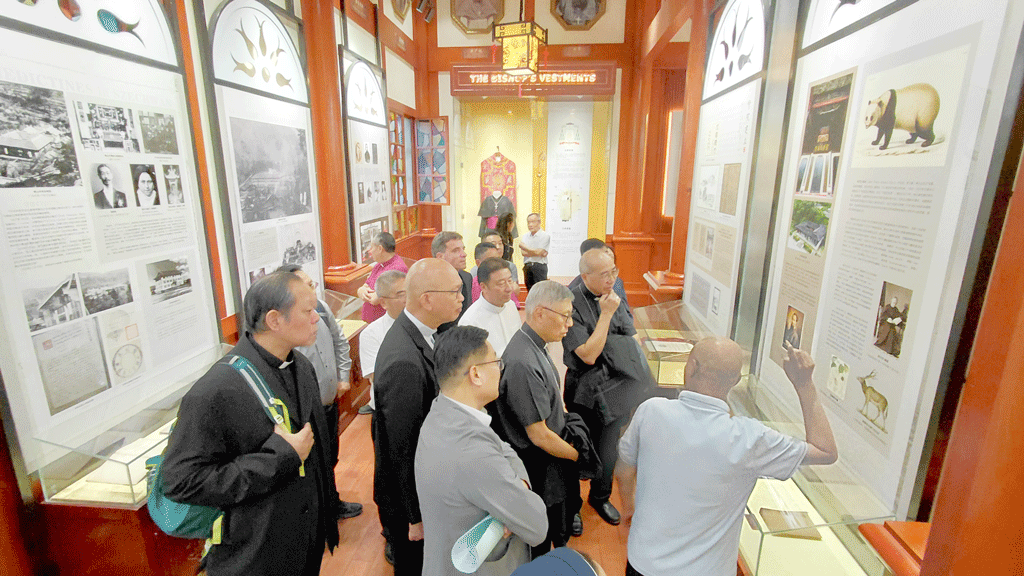
They recognised that this was the necessary step to take, because the proclamation of Christ’s salvation can reach every human community and every person only if it is spoken in their “mother tongue.”
They understood the mission of the Church was to “evangelise, not colonise.” Chinese Catholics, in communion with the pope, bear witness to their faith, and offer a genuine contribution “to the harmony of social coexistence and to the building of our common home.” 1
Sinicisation can offer the Church an opportunity for a deeper cultural dialogue, even as some Catholics express concern that it may at times place pressure on the Church’s pastoral freedom
Sinicisation can offer the Church an opportunity for a deeper cultural dialogue, even as some Catholics express concern that it may at times place pressure on the Church’s pastoral freedom. Building on this historical foundation, contemporary Church leaders emphasise the importance of dialogue.
Cardinal Stephen Chow, S.J., said that now is “an important time for the Church to have dialogue with the intellectual scholars of China on sinicisation.”
The cardinal added, “Sinicisation is not going to go away. It is here, so we need to engage in dialogue.”2
This emphasis on dialogue is echoed by bishops within China. Bishop Joseph Yang Yongqiang of Hangzhou said that the Church in China is the same as the Catholic Church in other countries, “we belong to the same faith, share the same baptism, and we are all faithful to the one, holy, catholic and apostolic Church. We effectively adapt to society, serve it, adhere to the direction of the ‘sinicisation’ of Catholicism, and preach the Good News.”3
Looking at how the Church in Sichuan is practising sinicisation, Father Peter Choy, vicar general of the Diocese of Hong Kong, says, “it should therefore be seen not as a threat, but rather as an opportunity to proclaim the gospel and bear witness to the faith in contemporary China.”4
Sinicisation is not going to go away. It is here, so we need to engage in dialogue
Cardinal Stephen
The relationship between synodality and sinicisation is dynamic and evolving. While sinicisation presents conflicts and challenges, synodality provides a framework for the Church to address them—walking together to discern a path towards a more harmonious relationship between Church and state.
Thus, the interplay of these two concepts opens up space for dialogue, grounded in the lived experience of the Catholic Church in China.
This evolving relationship is also visible in recent synodal events. Bishops from mainland China were able to participate in the Vatican Synod on Synodality in 2023 and 2024. In the 2023 Assembly, the two delegates were Bishop Joseph Yang Yongqiang and Bishop Anthony Yao Shun of Jining. In the 2024 assembly, Bishop Yang returned for the second session and was joined by Bishop Vincent Zhan Silu of Xiapu [Funing], who replaced Bishop Yao.
This was made possible by the 2018 Provisional Agreement between the Holy See and China. The participation of these Chinese bishops in the synod exemplifies a dialogue that seeks to balance adherence to state policy [sinicisation] and participation in the universal Church’s journey [synodality].
The synod also allowed dialogue between bishops from mainland China and Taiwan, displaying how the synodal process can foster unity and communion across the divide.
While sinicisation presents conflicts and challenges, synodality provides a framework for the Church to address them—walking together to discern a path towards a more harmonious relationship between Church and state
Sinicisation grounds the Church in a concrete cultural and social reality, while synodality equips the Church with the spiritual discipline to engage that reality with integrity. Chinese Catholics need not choose between their Catholic faith and their Chinese identity.
Through the synodal journey—listening to the Spirit, to one another, and to their culture—they discover that these two identities are one.
The harmony they cultivate is not a concession to political pressure, but a gift of their cultural heritage to the universal Church and a free reception of the Church’s faith into their native soil. The result is a Church that is Chinese by culture, Catholic by faith, and synodal by method—a space where the Holy Spirit builds a bridge that no policy can easily dismantle.
Bishop Zhan pointed out that the 17th century Chinese Rites Controversy teaches us a lesson in failed synodality: “From a historical perspective, one of the reasons for this setback was that the Church ignored the differences and complementarity of human cultures.”5
A synodal Church must respect and listen to the voices of different cultures and traditions. Synodality can be a way to navigate the currents of cultural challenges.
Through the synodal journey—listening to the Spirit, to one another, and to their culture—they discover that these two identities are one
Viewed together, these perspectives show how synodality and sinicisation can enrich one another. In summary, a truly synodal Church in China would become an agent of genuine ecclesial sinicisation—by listening to the sensus fidei of the Chinese faithful, their cultural wisdom, their joys and sufferings, the Church can discern how the Holy Spirit is at work in Chinese soil.
A successfully synodal Chinese Church would be an immense blessing to the universal Church, demonstrating how to be deeply rooted in local culture while maintaining full communion with Rome, and offering an antidote to crass materialism and secularism.
This concept and experience may also offer modest guidance to other local Churches as they seek to integrate faith within their own cultural contexts.
1 The Holy See, “Video Messge of the Holy Father Francis to mark the Conference, 100 years since the Concilium Sinense: Between History and Present,” https://www.vatican.va/content/francesco/en/messages/pont-messages/2024/documents/20240521-videomessaggio-concilium-sinense.html.
2 Justin McLellan, “Chinese cardinal calls for dialogue on ‘sinicisation’ of Church in China,” https://www.usccb.org/news/2024/chinese-cardinal-calls-dialogue-sinicization-church-china.
3 Cindy Wooden, “A synodal church respects cultural differences: Chinese bishop,” https://www.ucanews.com/amp/a-synodal-church-respects-cultural-differences-chinese-bishop/106756.
4 Marta Zhao, “Cardinal Chow: ‘Sinicization’ requires reflection based on knowledge, not rejection based on ignorance,” https://fides.org/en/news/77829Cardinal_Chow_Sinicization_ requires_reflection_based_on_ knowledge_not_rejection_based_on_ignorance.
5 Cindy Wooden, “A synodal church respects cultural differences: Chinese bishop,” https://www.heraldmalaysia.com/news/a-synodal-church-respects-cultural-differences-chinese-bishop/78889/2.