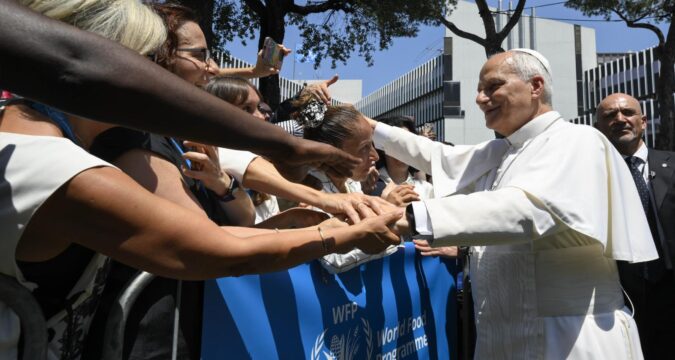
(OSV News): World hunger has only worsened as conflicts in the world take priority over human lives and weaponry is allowed more distribution than basic humanitarian needs, Pope Leo XIV said on June 22.
Addressing members of the United Nations’ World Food Programme [WFP], the pope said that while alleviating human suffering “is widely recognised as essential in principle,” humanitarian needs have taken a back seat to “international priorities.”
The pope said, “In effect, conflicts are ‘fed’ more readily than people are nourished. This reality reflects not only operational shortcomings but also a fundamental imbalance in political and moral priorities.”
The world’s largest humanitarian organisation addressing hunger and promoting food security, WFP is present in over 120 countries and territories. As of June 2026, it has provided 15.8 billion food rations worldwide, the organisation said.
Arriving at the WFP headquarters, the pope was welcomed by Cindy McCain, the organisation’s former executive director. McCain, the widow of the late US senator, John McCain, announced in February that she would step down as head of the WFP to focus on her health after suffering a mild stroke in October 2025.
You have spoken for them with courage and with love—not as statistics, but as brothers and sisters, human beings made in the image of God, deserving of dignity, of care, and of enough food to live and to thrive.
Cindy McCain addressing Pope Leo XIV
In her welcome address, McCain said that for those suffering from hunger, the pope’s voice was “one of—if not the—the most powerful on earth.”
She said, “You have spoken for them with courage and with love—not as statistics, but as brothers and sisters, human beings made in the image of God, deserving of dignity, of care, and of enough food to live and to thrive.”
In his address, Pope Leo said the WFP’s commitment to those in need “resonates profoundly with the Catholic Church’s mission to uphold human dignity and to foster fraternity, rooted in the gospel’s call to love our neighbour.”
Reflecting on crises that have evolved from “isolated events into persistent realities,” the pope said that due to a lack of a “shared ethical horizon,” the world has instead shifted from “multilateralism toward a disorderly and conflict-ridden multipolarism with a prevailing sense of mistrust.”
He said, “This trend reveals a striking paradox: unprecedented global productive capacity exists alongside expanding zones of extreme vulnerability.”
Pope Leo said, “The same forces that drive economic growth often exacerbate exclusion and marginalisation. Although alleviating human suffering is widely recognised as essential in principle, humanitarian concerns increasingly risk being relegated to a secondary place among international priorities.”
The pope also lamented the “progressive bureaucratisation of solidarity” coupled with “the quiet commodification of human life,” which results in delayed assistance to those in need due to bureaucratic red tape and the access to essential aid, especially food, being influenced “by economic or strategic considerations.”
The same forces that drive economic growth often exacerbate exclusion and marginalisation. Although alleviating human suffering is widely recognised as essential in principle, humanitarian concerns increasingly risk being relegated to a secondary place among international priorities
Pope Leo XIV
Calling for a “renewed commitment to multilateral cooperation,” the pope appealed to governments worldwide to increase resources for fighting hunger and “to remove the obstacles that prevent aid from reaching those in need.”
He said, “Access to adequate food is a fundamental human right grounded in the dignity of every person. Meeting this need not only alleviates suffering but also addresses the underlying causes of geopolitical instability. Indeed, food security is an essential component of global and integral security.”
After his address, the pope held a video call with six WFP front-line workers stationed in various parts of the world, including Venezuela, Senegal, South Sudan and Lebanon.
Expressing his gratitude, Pope Leo assured them of the “prayers and support for the worldwide community and especially the Catholic Church, which is oftentimes a partner in collaboration with the programs that you oversee.”
The pope encouraged them to continue their work in delivering aid to those in need and invoked God’s blessing in their “very important labour.”
Pope Leo also reflected on the value of community, which he said is needed in today’s polarised world, “affected by so many conflicts and wars where the destruction of human relationships continues because of so many different reasons, including technology.”
He said, “Instead of technology helping us to make a better world in which to live, it’s oftentimes being used as a method of war destruction and death.”
He said, “The work that you do, and perhaps even more than the work you do, the spirit that you share as you all work together in building a community and reaching out to those communities that are in need, is indeed a special gift.”
Related posts:
Philippine Church alarmed by weakened protections for indigenous communities
Video interview: A Decade of Ecumenism between the Anglicans and Catholics in Hong Kong

Asia’s bishops asked to warn against unapproved Korean shrine