Over 2,000 years ago, during the cruel and vindictive reign of King Herod in Judea, all boys aged two and under in Bethlehem were slaughtered in an attempt to eliminate the baby Jesus, whom Herod saw as a threat to his power. Mary and Joseph fled with Jesus to Egypt, where they found refuge until Herod’s death some years later. Afterwards, they returned home to Nazareth.
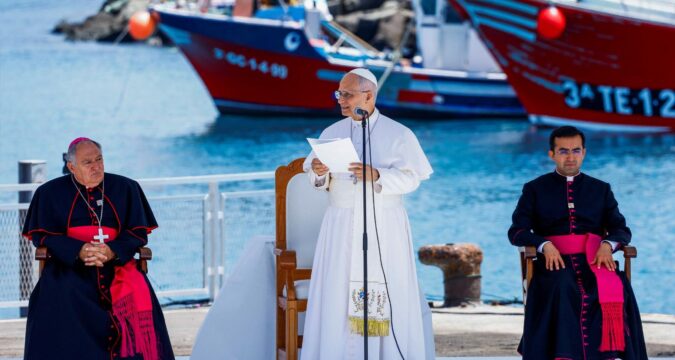
This episode in the life of Jesus underscores the Christian value of respecting the rights and dignity of migrants, a principle honoured ever since. Pope Leo XIV’s visit to Spain this past week reinforced this important value. The country’s socialist-led government has demonstrated solidarity and respect for displaced people by regularising the status of more than 500,000 undocumented migrants and asylum seekers.
This stands in stark contrast to the policies of other European countries and the United States, which reject and mistreat such people. The prevailing political climate across Europe has shifted significantly to the right, viewing irregular migration as a threat and migrants as potential criminals or undesirables.
Their policy is one of deterrence, seeking to block migrants from entering rather than accepting, supporting, and helping them integrate, as Spain has done. Mainstream European governments, such as Germany and France, have tightened residency laws and slashed quotas for refugee resettlement, making legalisation almost impossible.
In the United Kingdom, the government has attempted to deport migrants to African countries willing to accept them in exchange for payment. The European Union heavily funds North African countries, such as Tunisia, Egypt, and Morocco, to intercept migrants before they reach European shores.
The tragic drama of migration … challenges the conscience of nations and the ethical foundation of the international order
Pope Leo
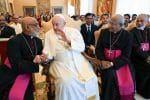
This is what Pope Leo spoke out against in an address to Spain’s parliament—which later received a seven-minute standing ovation. He told legislators that countries had a moral duty to accept and protect migrants.
“The tragic drama of migration … challenges the conscience of nations and the ethical foundation of the international order,” he said. “Numerous men, women, and children are forced, often by dramatic circumstances, to leave their communities and abandon loved ones, their histories, and their connections.”
The “universal principle of the equal dignity of all human beings,” he added, was violated if people found themselves discriminated against “because of their national, ethnic, religious or linguistic origin, or because of their economic or social status.”
The pope also pointed out the divisions in societies throughout the world, especially in Europe, where racism and anti-migrant sentiment pose grave challenges, even threats, to migrants escaping oppression, persecution and dire poverty in their respective homelands and seeking freedom and a new life in Europe.
As we celebrate the 500 years of Christianity in the Philippines. The Chaplaincy to Filipino Migrants organises an on-line talk every Tuesday at 9.00pm. You can join us at:
https://www.Facebook.com/CFM-Gifted-to-give-101039001847033
Opponents of migration in Spain have called for deportations, but Spain upholds the rights of migrants and supports their economic integration, provided they have a clean record. The country regards them as a hidden workforce that pays taxes and has chosen a pragmatic, humanitarian approach. Through a historic royal decree, Spain launched an extraordinary regularisation process between April and June 2026.
The Filipino migrant diaspora is one of the largest in the world. Approximately 15 million Filipinos live outside the Philippines. The Philippine Statistics Authority estimates that 2.19 million work abroad as overseas Filipino workers [OFWs] on temporary contracts. An estimated 200,000 to 300,000 Filipinos live in Spain, and every year, approximately 2,000 of them become Spanish citizens after only two years of legal residency.
The Filipino migrant diaspora is one of the largest in the world. Approximately 15 million Filipinos live outside the Philippines
Integrated community
It is not surprising that Filipinos are considered the most integrated immigrant community in Spain. The Philippines was once a Spanish colony and introduced Catholicism to the country.
The national hero, Dr. José Rizal, had profound intellectual, personal, and political connections to Spain. He travelled secretly to the country in 1882 to finish his education. He attended the Universidad Central de Madrid, earning degrees in medicine, philosophy and literature. His writings, especially his novels, were considered subversive.
After he returned to the Philippines, the Spanish colonial government had him executed on 30 December 1896, by a firing squad of Filipino troops, backed by Spanish soldiers, at Bagumbayan [now Rizal Park] in Manila. His execution ignited the Philippine Revolution against Spain.
Pope Leo challenged politicians and society to evaluate their morals by how they protect the most fragile of people. He said safeguarding human life from “conception to its natural end” is a fundamental goal of civilisation, and not a partisan issue. He challenged Spain to provide safe legal pathways and respectful integration for migrants.
He also challenged the international community to fix the root causes of poverty, violence, and climate change so that “no one has to leave their home due to a lack of peace.”
Pope Leo challenged politicians and society to evaluate their morals by how they protect the most fragile of people
Spain is a highly secularised society; only an estimated nine million people are practising Catholics out of a total population of 49.69 million. About 1.2 million attended Pope Leo’s Mass in Madrid, where he spoke about the right to life. Abortion and euthanasia are both completely legal and regulated by law in Spain, and these services are part of the Spanish healthcare system.
“All human life must be recognised and protected from conception to natural death, in every circumstance of its existence. When this certainty is obscured, the most vulnerable become the first victims, and the law loses its deepest meaning: to serve and protect every person,” the pope said.
“Therefore, the moral greatness of a nation is shown, above all, in its capacity to accompany, protect, and love those lives that are most fragile,” he added.
He also had much to say about clerical child abuse in Spain. A landmark 2023 report by Spain’s national ombudsman, Ángel Gabilondo, used an extensive public poll to project that 0.6 per cent of Spain’s adult population—roughly 200,000—were abused by clergy. That figure jumps to 400,000 [1.13 per cent] when it includes lay staff at Church-run schools and institutions.
The Spanish Church stated in June it had uncovered 927 cases of clerical child abuse through a complaints procedure launched in 2020. There are almost no convictions of clerical child abusers, as more than 60 per cent of the accused clerics are already deceased, and the Spanish statute of limitations has prevented legal action against the abusers.
Pope Leo had this to say about it: “Faced with this scourge, the ecclesial community is called to respond with listening, truth, justice, reparation and an ever more determined commitment to prevention and a culture of care.”
The pope said, “Every wounded person must be able to find sincere listening, welcome, protection and real paths to healing.”
With these words, he could well have been addressing the Philippine clergy as well.

Father Shay Cullen
www.preda.org