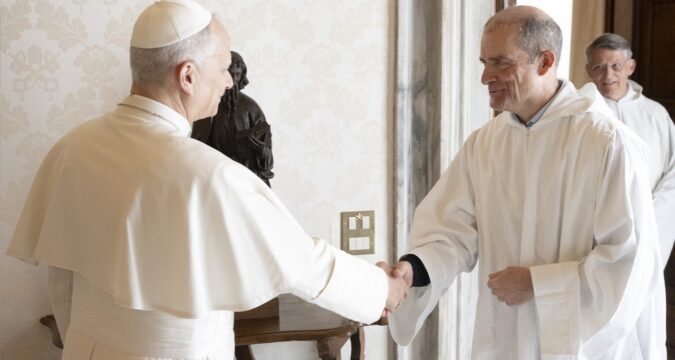
(SE): In a private audience at the Vatican on March 21, Pope Leo XIV welcomed Brother Matthew, the prior of the ecumenical Taizé Community, to discuss pressing issues ranging from Christian unity to the plight of young people and the ongoing suffering in conflict zones Vatican News reported on March 25.
The meeting, which continued a longstanding tradition of dialogue between the Vatican and Taizé, took place against the backdrop of global instability and rising concerns about indifference in society.
“It was my second audience with the Holy Father, Brother Matthew said, “I had already met him in July of last year. It has historically always been a tradition that the prior of Taizé comes to Rome in March, and I asked if it would be possible to meet with him again. They said yes right away, which was a great joy.”
Brother Matthew said Pope Leo XIV affirmed the vocation of the Taizé Community as an ecumenical group, emphasising the importance of unity among Christians from different denominations. He noted that the pope recognised the ministry of the Bishop of Rome as a servant of unity within the people of God, expressing gratitude for this focus. Unity and peace, according to Brother Matthew, remained central themes throughout their conversation.
The meeting also addressed the suffering in regions affected by war, including Ukraine and the Middle East. Both leaders shared concerns about ongoing conflicts and discussed the need for concrete signs of solidarity. Brother Matthew explained that they reflected on how to open new paths for dialogue and peace, stressing that “weapons do not produce the result that is peace.” The dialogue further explored ways to encourage unity both among Christians and within the Catholic Church itself.
Brother Matthew said Pope Leo XIV affirmed the vocation of the Taizé Community as an ecumenical group, emphasising the importance of unity among Christians from different denominations
Brother Matthew highlighted Pope Leo’s deep concern for young people, particularly in the wake of the pandemic. He observed that many young people experience isolation, even as they remain digitally connected. At Taizé, he said, “many come from situations of isolation, but through the experience that we offer, they rediscover the importance of life with others, life in community.”
He praised the pope’s remarkable capacity to listen, describing him as generous with his time and deeply committed to accompanying those who seek guidance.
Reflecting on leadership, Brother Matthew said, “Listening does not mean we must agree on everything, but it creates a space where we might take steps together we never expected before.” He stressed that respectful listening, even amid disagreement, sends a powerful message in today’s divided world.
Looking back on the origins of Taizé, Brother Matthew recalled that the community was founded during the Second World War by Brother Roger, who left Switzerland for France to offer a sign of peace and hope in a divided land. The brothers’ ongoing mission, he said, is to be present both in Taizé and at points of “fracture in the human family.”
This story of our foundation speaks to me a lot today, and I see very much the call for our brothers to be present not only in Taizé, where we welcome large numbers of young people, but also at the points of fracture in the human family.
The meeting also addressed the suffering in regions affected by war, including Ukraine and the Middle East. Both leaders shared concerns about ongoing conflicts and discussed the need for concrete signs of solidarity
He warned against the growing spirit of indifference in Western societies, cautioning that distant wars can have direct consequences on freedom and faith. “If we fall into indifference, then very quickly these situations will also weigh on our shoulders,” he said.
Brother Matthew called for concrete signs of solidarity with those struggling for freedom around the world. He encouraged people to maintain contact with friends in troubled regions, saying, “Don’t forget them.”
He acknowledged that discouragement remains a challenge, but said he finds hope in the resilience of people he’s met in Ukraine. Recalling a visit to Zaporizhzhia, he said he experienced “Christmas where the light shines in the darkness, and the darkness was not able to overcome it.
“We need the testimony of the people living in these situations. We need to hear their stories. We need to visit the cemeteries to understand really what is going on.”
Brother Matthew reflected on Christian responsibility, saying, “Jesus asks us to love our neighbour as ourselves. That means I cannot fall into indifference when faced with what is happening to my neighbour.” He drew a direct link between attention to those who suffer and attention to Christ, referencing the Pope’s message that “the poor cannot be separated from Christ.”
Jesus asks us to love our neighbour as ourselves. That means I cannot fall into indifference when faced with what is happening to my neighbour
Brother Matthew
He said that while not everyone can travel to conflict zones, everyone can pray. “It is that prayer which keeps us awake, which means we are not forgetting these situations, and which can perhaps inspire intuitions within us—ways to help others, perhaps refugees in our countries, or people who are vulnerable because they have had to leave their homes. That is possible for everyone. Everyone can pray.”
He acknowledged the danger of “compassion fatigue,” noting that everyone has different capacities to face suffering and that limitations do not equate to indifference.
I see that with my brothers as well. For some of them, they get so wrapped up in the suffering that they are no longer free. That is very difficult, and it needs accompaniment. Each of us needs to understand what we can bear. But I think, for all of us, there is always the possibility to remember the situation in prayer.
Many young people come to Taizé searching for community, often after experiencing isolation. “When they understand it’s a safe environment, something often opens up within them,” Brother Matthew said.
He observed that the rhythm of prayer at Taizé, especially the silence during worship, is what most deeply touches young visitors. “There’s a desire for silence,” he said. “We’re created in the image of God, and there is this deep desire to be in the presence of God. Silence enables that, even if many young people don’t have the vocabulary to express it in words. They sense intuitively that they are in the presence of someone greater than themselves.”
We’re created in the image of God, and there is this deep desire to be in the presence of God. Silence enables that, even if many young people don’t have the vocabulary to express it in words. They sense intuitively that they are in the presence of someone greater than themselves
Brother Matthew
He said many visitors come from non-Church backgrounds, but still express an authentic spiritual longing. The community’s role, he added, is to listen and help young people articulate their experiences.
At Taizé, Brother Matthew said, “we open the doors, we sing a little, and then the rest doesn’t depend on us.” He added that young people discover the value of journeying together, even when they hold different opinions. “There’s a risk in that, but it’s a risk worth taking,” he said.
Turning to the upcoming European Youth Meeting in Łódź, Poland, Brother Matthew explained that the character of each gathering is shaped by local cultures and the needs of the Church. Recent meetings, he said, have seen new elements introduced in response to local realities—an approach he expects to continue in Poland.
He noted that the meeting had been eagerly anticipated by local Church leaders. With Cardinal Krajewski now serving as Archbishop of Lodź, Brother Matthew expects a warm welcome for participants, especially those from Ukraine.
He pointed out that the decision to host the meeting in Poland was influenced by the significant Ukrainian diaspora, with more than a thousand young Ukrainians attending the previous gathering in Paris.
“It’s not simple for them to make the journey to Paris, but when we’re in Poland, it’s much easier,” he said. “Offering that space where they understand they are truly part of the European family is very important during this time.”