John Singarayar, SVD
My grandfather kept a small wooden cross above his bed his entire adult life. When he died, we found a note tucked behind it that none of us had ever seen — just a few lines, in his handwriting, that said he was not sure what he believed anymore but that he kept coming back to Easter because he could not explain it away. He was eighty-one when he wrote it.
I think about that note more than I probably should.
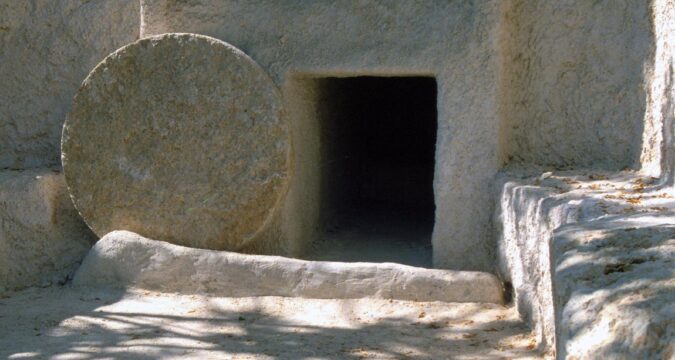
There is something almost absurd about building a faith on absence. No relic, no inscription, no remains. Just a hollow space where a body should have been. And yet here we are, two thousand years later, still arguing about it — in seminaries and hospital corridors and the quiet of minds that cannot quite let the question go. My grandfather was not a theologian. He was a farmer who went to Mass every Sunday and doubted every Monday. And he kept showing up anyway. That feels more like resurrection faith to me than most of what I have read about it.
The gospel accounts of Easter morning are not triumphant. They are disorienting. The women arrive at dawn and find nothing. Peter runs to check and goes home confused. Faith does not spring up clean and confident from the empty tomb—it stumbles into the light, blinking. That detail matters, and we tend to skip past it. Doubt is not the enemy of resurrection faith. For most of the people who have ever held it, doubt has been its closest companion.
There is something almost absurd about building a faith on absence. No relic, no inscription, no remains. Just a hollow space where a body should have been. And yet here we are, two thousand years later, still arguing about it
The comfortable tomb
Here is something nobody says out loud in most churches: faith can become furniture. Familiar, unremarkable, easy to stop seeing. You keep it around because it has always been there, because getting rid of it would feel like a statement, because Sunday mornings have a shape, and the shape is comfortable.
The empty tomb is genuinely bad news for that kind of religion. It resists domestication. If Christ is actually risen—not as a metaphor, not as spiritual consolation, but actually, bodily, historically risen—then the Church is not a heritage organisation preserving sacred memories. It is something far more disruptive and far more demanding.
The last decade has made this painfully clear. Abuse scandals, institutional cover-ups, the spectacle of religious leaders wielding power with none of the accountability they preach. None of this is new, exactly. But the scale of the reckoning has been. And what strikes me—what should strike any honest believer—is that the empty tomb does not excuse any of it. It indicts it. A community that proclaims new life and simultaneously protects structures that crush people is not just failing morally. It is contradicting its own central claim. The resurrection is the worst possible alibi for institutional cowardice.
Hope that has actually suffered something
I used to be suspicious of religious hope. It seemed to me—in my twenties, when I was certain about several things I am no longer certain about—that hope was what people reached for when they could not bear reality. A kind of dignified denial.
I am less sure of that now.
If Christ is actually risen—not as a metaphor, not as spiritual consolation, but actually, bodily, historically risen—then the Church is not a heritage organisation preserving sacred memories. It is something far more disruptive and far more demanding
Not because the world got better. It did not, particularly. But because I came to understand that Easter hope was never born from easy circumstances. It emerged from a crucifixion — state violence, public humiliation, the particular despair of watching someone you loved die while you stood at a distance and did nothing. The disciples knew what failure felt like before they knew what resurrection felt like. The empty tomb stands on the far side of that darkness. Not around it. Not instead of it. Through it.
That distinction changes what religious communities are actually called to do. Not to offer cheerful reassurance to people in pain. Not to perform optimism in a burning world. But to stay in the room with the suffering—honestly, without platitudes—and then to demonstrate, in small and costly ways, that fear does not have to set the agenda. That reconciliation is possible even when it hurts. That the story is not over.
I have seen communities do this. Not many. But I have seen it, and it is not nothing.
The freedom nobody talks about
There is a quiet corruption spreading through a lot of contemporary religious life, and almost nobody names it directly. It is the slow surrender to the same metrics that drive everything else: attendance, growth, visibility, and applause. When a congregation starts measuring its spiritual health by how many people show up—or how many follow them online—something essential has already been lost. Usually long before anyone notices.
The empty tomb, if you take it seriously, frees communities from needing to win in worldly terms. Faithfulness can look like smallness. Integrity can cost you the room. Serving the forgotten does not trend
The resurrection story begins in total apparent failure. The one convicted as a criminal is revealed as Lord. That inversion cuts against every institutional instinct. The empty tomb, if you take it seriously, frees communities from needing to win in worldly terms. Faithfulness can look like smallness. Integrity can cost you the room. Serving the forgotten does not trend.
That freedom matters to individual believers too—perhaps most of all. A lot of people carry a low-grade spiritual guilt they never quite shake. The sense that their faith is thinner than it should be, their doubts too loud, their prayer life a mess. I know that feeling personally. But the first witnesses at the tomb were not models of composure. They were frightened and confused and running. The resurrection met them there, in the middle of their failure to understand. It did not wait for them to be ready. That is probably the most important thing about it.
The part you actually live
The resurrection is not primarily a position to defend. It is a practice. It becomes real—or it stays theoretical—in very ordinary moments. In whether you offer the forgiveness that would cost you something. In whether you tell the truth when silence would be safer. In whether your community actually shows up for people nobody else is showing up for.
I keep coming back to my grandfather’s note. He was not sure what he believed. He kept coming back anyway. And maybe that is closer to the truth of it than any of the confident proclamations. The empty tomb does not demand certainty. It demands a decision — made again, quietly, every day — about whether to live as if the grave is not the final word.
He kept the cross above his bed until the day he died. That was his answer. It is not a bad one.