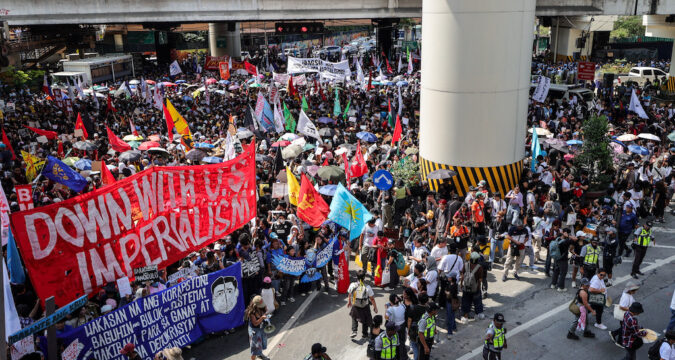
MANILA (LiCAS News): Marking the 40th anniversary of the 1986 EDSA People Power uprising on February 25, Bishop Gerardo Alminaza of San Carlos, president of Caritas Philippines, called for a “culture of accountability,” saying the spirit that restored democracy must now confront corruption, poverty, and human rights violations that persist four decades later.
Bishop Alminaza delivered the message during a protest rally near the National Shrine of Mary, Queen of Peace, or EDSA Shrine.
He stressed that the anniversary of the uprising is not only a remembrance but also a renewed call to action.
“Forty years ago, there was a flood on EDSA. Not a flood of water, but a flood of people. A flood of courage and a flood of conscience,” he said.
Bishop Alminaza said ordinary Filipinos “filled this highway because they felt that injustice could no longer be endured. They reclaimed democracy with moral conviction.”
The bishop stressed that the historic uprising must not be reduced to partisan memory or generational ownership.
Forty years ago, there was a flood on EDSA. Not a flood of water, but a flood of people. A flood of courage and a flood of conscience
Bishop Alminaza
“EDSA does not belong to any party or administration. It does not belong to a single generation. It belongs to the people,” he said.
Tensions escalated before the bishop’s address when police deployed hundreds of anti-riot officers to block protesters from advancing toward the EDSA Shrine.
Authorities said organisers had not secured a government permit for the rally. The heavy police presence triggered a confrontation as demonstrators attempted to move forward.
As we celebrate the 500 years of Christianity in the Philippines. The Chaplaincy to Filipino Migrants organises an on-line talk every Tuesday at 9.00pm. You can join us at:
https://www.Facebook.com/CFM-Gifted-to-give-101039001847033
Civic leaders, including Bishop Alminaza, engaged police commanders in negotiations, asserting that the commemoration of EDSA is a public exercise of democratic space.
While discussions were ongoing, protesters pressed through police lines and gathered near the shrine to continue the programme.
A truck intended to serve as the main stage was prevented from passing, forcing organisers to improvise. Bishop Alminaza and other speakers addressed the crowd from a pickup truck positioned at the intersection of EDSA and Ortigas Avenue.
EDSA does not belong to any party or administration. It does not belong to a single generation. It belongs to the people
Bishop Alminaza
The bishop noted that the country continues to experience new “floods”—corruption, inequality, and abuse of power—that demand a collective response.
“There is a flood of corruption,” he said, referring to public funds meant for flood control projects, hospitals, education, and housing that are lost or misused. “Transparency is promised, but lacking. Accountability is demanded, but insufficient.”
Bishop Alminaza also pointed to labour insecurity, displacement of urban poor communities, and the struggles of indigenous peoples defending ancestral lands.
“These are not separate issues. These are structural injustices. Evils that become normal because the system allows them. Tolerated evils!” he said.
The bishop cited ongoing proceedings at the International Criminal Court related to the previous administration’s war on drugs, describing them as “a significant step toward breaking the culture of impunity.”
He said, “It is not about revenge. It is about accountability. It is a reminder that no one is above the law, and that the lives of the poor matter.”
Transparency is promised, but lacking. Accountability is demanded, but insufficient … hese are not separate issues. These are structural injustices. Evils that become normal because the system allows them. Tolerated evils!
Bishop Alminaza
However, the bishop stressed that accountability must extend beyond a single case.
“Accountability should not be tied to just one case. It must become a culture,” he said.
Drawing from the memory of 1986, Bishop Alminaza urged Filipinos to respond peacefully but firmly to injustice.
“Let us flood the streets—not to cause disorder, but to peacefully express opposition to corruption and injustice,” he said. “Let us flood social media with truth, not disinformation or misinformation.”
The bishop introduced the Visayan term, “Hayuma” or “Paghahayuma” [mend, repair] describing it as “when torn nets are patiently mended so they can cast them again into the sea—a quiet, shared work of repairing what is damaged so life and livelihood may continue.”
He said, “In the same way, hayuma in the pastoral sense is about mending what injustice has torn—restoring dignity, rebuilding trust, and repairing broken social structures together so communities can thrive again.”
Love must defend life. Love must protect the vulnerable. Love must demand accountability. Love must shape public life
Bishop Alminaza
Quoting Pope Leo XIV’s apostolic exhortation Dilexi Te, the bishop reminded listeners: “I have loved you.”
Bishop Alminaza emphasized, “Love must defend life. Love must protect the vulnerable. Love must demand accountability. Love must shape public life.”
The bishop stressed, “EDSA is not only a memory of what we did before. It is a question to us now: What will we do?”
Two separate mobilisations marked the 40th anniversary of People Power along EDSA. A Church-led coalition, the “Trillion Peso March Movement,” organised a rally at the People Power Monument after securing a government permit.
The other gathering proceeded without a permit and faced police restrictions.
Earlier this month, Bishop Alminaza joined civic leaders in efforts to unify the anniversary activities. The commemorations ultimately took place as two distinct events, both with participation from Caritas Philippines.