“The Word became flesh and made His dwelling among us, and we saw His glory” (John 1:14)
Dear fellow Hongkongers and friends,
When we start hearing Christmas carols or receiving Christmas cards, we know that Christmas is near. We are preparing to welcome this great festival of joy and hope. However, the recent disastrous fire at Tai Po brought us once again to a keen awareness of the fragility of life. So, why celebrate Christmas during this difficult time when many of us are still saddened by the tragedies?
Christmas is here precisely to assure us that the Son of God has become one of us, sharing fully the ‘sweetness, acidity, bitterness and heat’ of our humanity. The Son of God has since been intimately connected with us that we no longer struggle without a future. For Christmas means that we have a clear way out to a radically new and promising life.
But is our world ready to welcome this hope-filled festival? There are still war cries leading to senseless killings almost every day. Nations are applying extremism to counter extremism, creating a vicious cycle that shows no signs of ending. The world economy is not yielding sufficient improvements for the middle and working classes to become hopeful. Ironically, the rich continue to get richer while those struggling become poorer in their struggles. The local economy is still lagging, even though there are signs of recovery in the financial sector.
Humanity:
The Son of God takes on our humanity to make it noble once again. He also rescues humankind from our unending helplessness. Humanity is both sacred and imperfect. We must have seen or read about some altruistic acts by ordinary people that enabled their beneficiaries to, once again, live with dignity and hope through their heroic deeds.
But no one is perfect. Can we allow imperfections or even appreciate them for what they are? For imperfections are integral to our human nature. They can make us cry, but also laugh; angry, but also sympathetic; unforgiving, but also yearning for forgiveness. This is precisely the beauty of our complex humanity.
But humanity is becoming less of an affirming value than a cynical remark on the shortcomings of others. We should be aware that such a denial will lead to the self-destruction of humanity in the long run. Rather than eschewing each other’s imperfections, it is better to nourish the goodness in ourselves and in one another. After all, the Son of God has fully embraced our complex humanity, not rejected it.
Artificial Intelligence:
The news that has sparked high levels of enthusiasm and concern in 2025 is Artificial Intelligence (AI). It is a promising invention, supposedly for the good of humanity. It is true that AI can take care of the functional aspects of life, which is for our protection and development, if we use it wisely. But can AI ever replace or assume humanity?
It is a different scenario for AI when the focus is on human relationships. For example, when we enter into an affective relationship with another person, we need to allow ourselves to become vulnerable. We can be hurt, and probably more than once. AI cannot relate to us in that manner. Again, Christmas tells us that the Son of God has made himself vulnerable by entering our human history, calling us his sisters and brothers.
Of course, no invention is without drawbacks. To address the ethical dilemmas of applying AI, starting with education appears to be the better option. How can an inter-disciplinary curriculum prepare our students to benefit from AI, while critically understanding its pitfalls for personal to global developments?
Education:
When little Jesus was growing up in Nazareth, he must have received a basic education that equipped him with essential life skills, knowledge of his Jewish culture and religious faith, and the formation of his personhood.
However, education in Hong Kong has yet to shift its focus from functionality underscored by a utilitarian emphasis to a loving respect for the individuality of our young ones. Education should not be taken as an instrument that essentially serves the territory’s prosperity by providing young graduates for civil services, professional services, or the labour market, etc.
The essential mission of education is to teach children for self-discovery, not to be molded like the rest; to foster self-agency, not dependence; to build self-esteem, not boastfulness; for respect for others, not self-centeredness; for willingness to reach out and walk with others, not lording over them; to cultivate a deep desire for a better world, not to be sedentary in their own comfort zones; and to nurture a capacity to co-construct a better world with their peers and others.
There are other educational pathways besides the conventional way. These may be more suitable for children who thrive on different learning styles and have gifts yet to be discovered. We should encourage these different pathways to shine out so that our young people can celebrate their gifts on suitable platforms.
Young people:
Jesus, as we know from the Gospel, has a soft spot for children and youth. Underprivileged young people are struggling with low self-esteem and weak self-confidence in some parts of the world, including Hong Kong. Ironically, young people coming from better-off families are not faring that much better either. They, too, are suffering from similar issues, including constant competition. Are there no other values that are equally or more important than being competitive? What about life and hope?
When the pathways and opportunities are narrowing, even those who are capable are getting tired because they are being forced to engage in someone’s game rather than their own. They are well conditioned to live in other people’s expectations and frameworks, leaving little initiative in them. We used to say, “follow your heart” to our young people. Sadly, it has become an empty slogan.
Christmas is a time of giving. There are individuals who want to give back to society. How can they help create hope for our young people? First, listen empathically, understand, and learn from the young ones before they can identify how and what to give back. We hope that their giving back will be truly appreciated by our young people.
Hong Kong — where cultures meet and fuse:
Hong Kong has long been a city of migrants where inter-culturality is its hallmark. The beauty of cultures lies not in clashing but in creative fusions as they encounter one another. Discriminating against cultures other than the conventional ones will only hurt Hong Kong. Hence, we need to open ourselves to intercultural dynamics and welcome migrants so they can thrive in our city. Jesus and his family were migrants when they escaped to Egypt from the death threat ordered by their ruler of the time.
Finally, none of the above can be achieved with government policy alone. They require our goodwill, initiatives and collaborations beyond ideological and conventional boundaries, so that they can contribute to building a joyful and hopeful world. Let us be bridges among cultures, messengers of hope to those who need hope, especially during this difficult time after the tragedy, and a community that dialogues and journeys together!
I take this opportunity to wish you, our beloved Hong Kong, China and the world a joyful Christmas and a hope-filled 2026!

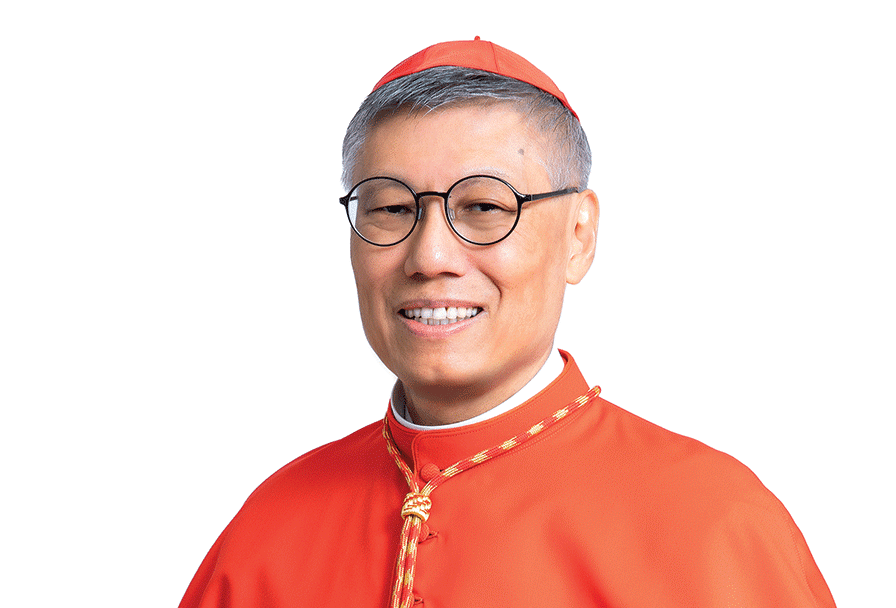
+ Stephen Cardinal Chow, S.J.