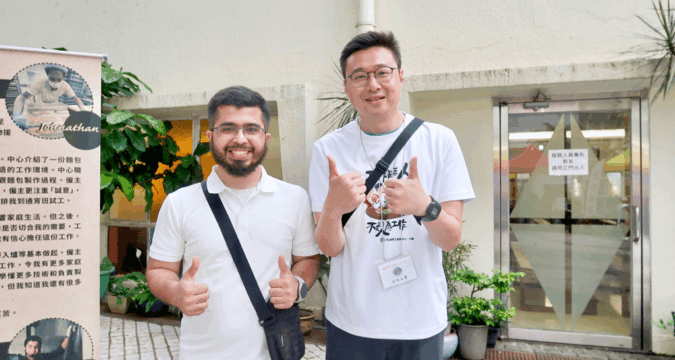
HONG KONG (SE): In a city dominated by towering skyscrapers, lifts and escalators are the literal lifeblood of daily movement. Among the dedicated technicians keeping Hong Kong moving is Tanveer Khan, a young Pakistani man. The young Muslim has found a second family within a local Catholic support network, overcoming immense cultural and language barriers to build a promising career.
Upon completing Secondary 6, Khan felt stuck in an airport baggage handling a job he did not enjoy. He had a deep passion for electrical work but had no idea how to navigate Hong Kong’s education system.
His turning point came when he met social workers at the Diocesan Pastoral Centre for Workers-Kowloon, whom he fondly refers to as his “elder brothers”. They opened doors for him, guiding him towards a certificate programme and later a higher diploma in mechanical engineering, focusing on lifts and escalators.
However, his studies brought an immediate wave of culture shock. As the only non-local student in his class, facing lectures and textbooks entirely in Chinese, Khan did not even know basic tool names. Instead of giving up, he chose to push through, staying behind after every lesson to ask questions and constantly practising reading, writing, and speaking Chinese.
Tseng Ka-chun, a social worker under the centre’s Ethnic Minority Service, has supported Khan throughout this journey. Recalling how they tackled those early hurdles together, Tseng praised Khan’s determination to rise to the challenge.
His turning point came when he met social workers at the Diocesan Pastoral Centre for Workers-Kowloon, whom he fondly refers to as his ‘elder brothers’. They opened doors for him, guiding him towards a certificate programme and later a higher diploma in mechanical engineering, focusing on lifts and escalators
He explained that he had arranged one-on-one Cantonese tutoring for Khan and frequently helped him understand various notices.
Tseng even took photographs to introduce Khan to basic equipment like flathead and Phillips screwdrivers, noting that Khan’s work colleagues naturally taught him much more later on.
Khan’s language skills have improved dramatically. Today, he is in his third and final year of the higher diploma course and speaks Cantonese so fluently that local residents say he sounds just like a native.
When talking about his job, Khan’s passion is unmistakable. While the thought of deep, dark lift shafts might terrify some, he loves the challenge. He enjoys engineering because of the instant feedback. “When you troubleshoot a broken machine and fix it, you can see the results immediately,” he said.
This professional instinct has carried over into his personal life. Whenever he uses the lift in his own residential building, he checks how it feels and sounds, proactively reporting any faults to neighbours or security guards.
For Khan, safety is the ultimate priority when dealing with dangerous electrical systems. “My responsibility is safety first. If I know how to do it, I do it. If I don’t, it doesn’t matter,” he says, stressing that technicians must never take unnecessary risks. “If the master is not free to come over, the firefighters will come and help… my responsibility is to stand there, sit inside the engine room, and do not mess around with things.”
Reflecting on his experiences, Khan advises other young South Asians in Hong Kong that mastering Chinese is essential to build a proper life. “You must work very hard on your Chinese, whether it is speaking or writing,” he urges. “I really want to live in Hong Kong.”
By crossing religious and cultural divides, Khan has transformed his life from uncertainty to clear purpose, shining as an essential builder of Hong Kong’s future.