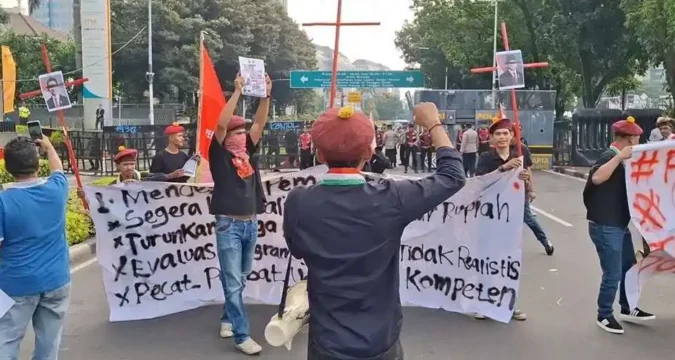
JAKARTA (UCAN): Catholic university students in Jakarta, Indonesia, have joined a growing national protest movement demanding that the government halt its flagship Free Nutritious Meal [MBG] programme, a multibillion-dollar initiative now embroiled in allegations of corruption, food poisoning incidents and a constitutional challenge.
The Central Jakarta chapter of the Indonesian Catholic Students Association [PMKRI] staged a rally on June 17, erecting a large red cross flanked by two smaller crosses bearing photographs of the country’s president, Prabowo Subianto, and vice president, Gibran Rakabuming Raka.
Chapter presidium chairperson, Johanes Jonianus Tae, said “The cross is not merely a religious emblem. It is a sign of siding with truth and resisting injustice.” He said the flanking crosses symbolized a call for political accountability rather than personal condemnation of the country’s leaders.
“What PMKRI criticises is not the personal dignity of the president or vice president, but the structure of power and policies that fail to address people’s suffering,” he said. “In the biblical narrative, both criminals had the opportunity to repent. We hope future policies will correct the failures we see today.”
Launched in January 2025, the MBG programme is facing mounting criticism over food safety. More than 11,000 students and school staff have reportedly suffered food poisoning since its launch. The largest single incident occurred in Cipongkor district in West Bandung, where more than 500 students fell ill in a single day. Local media reported that none of the district’s 85 MBG kitchens had passed food safety certification.
The cross is not merely a religious emblem. It is a sign of siding with truth and resisting injustice
Johanes Jonianus Tae
Governance concerns have deepened the controversy. The Attorney General’s Office has alleged that former senior officials of the National Nutrition Agency manipulated kitchen verification procedures to benefit affiliated foundations. Authorities say the number of licensed kitchens expanded from a planned 21,000 to nearly 27,900 through the alleged sale of permits. The agency’s former chief and two deputies have been detained.
Tae cited reports from remote regions, including the predominantly Christian province of East Nusa Tenggara, where meals allegedly arrived spoiled.
“How can such a flawed programme be continued?” he asked.
Kosmas Jedoko, principal of a Catholic school in Manggarai Regency on Flores Island, said that the programme had not yet reached his school and that he does not intend to participate.
“Our children are accustomed to food from their own gardens,” he said. “Meals prepared by officials can take hours to arrive. With so many poisoning cases, we have doubts. It would be better if the budget were managed locally.”
Meals prepared by officials can take hours to arrive. With so many poisoning cases, we have doubts. It would be better if the budget were managed locally
Kosmas Jedoko
The street protests are now accompanied by a legal challenge. Indonesia’s Constitutional Court is hearing a judicial review of the 2026 state budget law. Petitioners argue that MBG funding of about 223 trillion rupiah has been counted as part of the constitutionally mandated 20 per cent education budget, reducing spending on education and lowering the effective education allocation to 11.9 per cent.
Protests have intensified across the country. On June 12, hundreds of students demonstrated against fuel price increases, the weakening rupiah, and alleged mismanagement of the MBG programme.
By June 15, demonstrations had spread to Bandung and the provinces of North Sumatra and South Sumatra.
On June 18, the Alliance of Women in Indonesia, representing at least 90 women’s organisations protested outside the State Palace and called for a temporary suspension of the programme.
Indonesia’s largest Islamic organisation, Muhammadiyah, has also called for the programme to be halted.
Related posts:
Welcoming migrants, refugees is first step toward peace, pope says

Update: Pope Francis responding to treatment, will be in hospital at least another week

Malaysia’s bishops contribute to Covid-19 fund