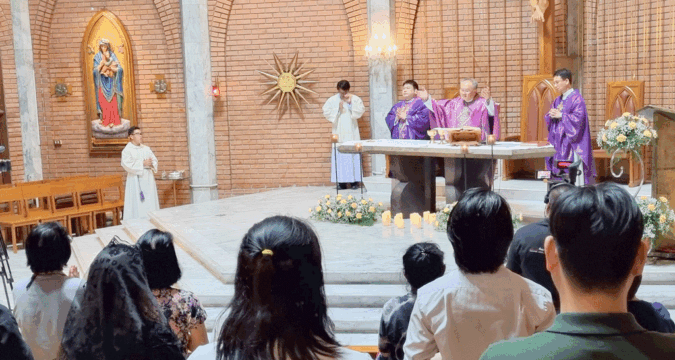
BANGKOK (LiCAS News): Catholics gathered in Bangkok, Thailand, on April 1, Wednesday of Holy Week, for a Mass for peace in response to Pope Leo XIV’s renewed call for an immediate ceasefire, as the Middle East conflict deepened and its economic fallout spread across Asia.
“We gather in the house of the Lord at a time when our world trembles under the weight of violent conflict,” said Father John Baptist Somkiat Trinikorn in his homily during the service at St. John the Evangelist Church.
“The repercussions are felt everywhere, shattering peace, unsettling faith, and disrupting societies, economies, and the very security of human life,” Father Trinikorn said.
The liturgy brought the faithful together in prayer as rising fuel costs and broader economic pressures underscored how a distant war is reshaping daily life in countries like Thailand, amplifying the Church’s appeal for both spiritual conversion and concrete action for peace.
Father Trinikorn emphasised both the power of prayer and the responsibility of believers to cultivate peace within themselves.
He invited the congregation to approach God not with routine recitations but with heartfelt urgency, offering their whole selves, including their fears, emotions, and hopes.
The repercussions are felt everywhere, shattering peace, unsettling faith, and disrupting societies, economies, and the very security of human life
Father John Baptist Somkiat Trinikorn
The priest described the human cost of war, pointing to the suffering of civilians, the destruction of homes, and a growing climate of fear across nations. Yet he contrasted the global turmoil with the stillness inside the church, where candlelight, silence, and prayer offered space for reflection and hope.
The faithful were invited to contemplate the mystery of betrayal in the Passion of Christ as the Church prepared to enter the Paschal Triduum, beginning with Holy Thursday.
“In this sacred space, we encounter Christ Himself, in His Word, in the Eucharist, and in our communion as His people,” Father Trinikorn said. “We do not gather to seek political explanations but because we believe that God alone is the answer to the deepest wounds of humanity.”
Drawing on the gospel message, he said true peace does not come through domination or the defeat of enemies but through the transformative power of the Cross.
“The world teaches that peace is achieved through power and victory,” he said. “But Christ reveals that true peace is born from the Cross, not as a sign of defeat but as the place where hatred is transformed into love and violence into reconciliation.”
He cautioned that prayers for global peace must be accompanied by personal conversion.
“If we ask for peace in the world while our hearts remain filled with anger, resentment, and division, how can peace truly take root?” he asked. “The path to peace begins within each of us.”
The prayer initiative came as the effects of the Middle East conflict rippled far beyond the region. Like many countries across Asia, Thailand is experiencing the economic consequences of the crisis, particularly through rising energy costs.
Fuel prices have surged almost daily, placing increasing pressure on households already coping with inflation. Although the government has attempted to stabilise the cost of essential goods through price controls, the measures have had limited success, underscoring the far-reaching impact of geopolitical instability.
In this context, the Church’s call to prayer and reconciliation gains urgency, pointing to a moral path toward lasting peace.