Sister Margaret OCD
Many of us know the feeling: Lent is over, the intense liturgies of Holy Week have passed, and Easter has come. Yet the long-for change still seems distant. Perhaps a relationship remains broken, a health crisis deepens, grief over the loss of a loved one persists, or the future looks uncertain. The night of life’s trials feels long, and the spirit grows weary waiting for the dawn. That’s where St. John of the Cross comes in to offer us his compassionate company and wise counsels.
A 16th century Spanish Carmelite priest, poet, mystic, St. John of the Cross wrote from the crucible of life. Raised in dire poverty and later subjected to harsh imprisonment during his reform work with St. Teresa of Avila, he not only knew the struggles of life firsthand, but, endowed with God’s special grace, discovered in suffering a pathway to deeper union with God and hence real transformation.
His luminous and profound poems and prose on the spiritual journey carry the authority and authenticity of lived experience; indeed, many of his most celebrated poems were born precisely during those months of confinement.
“Where have you hidden, Beloved, and left me moaning? You fled like the stag after wounding me; I went out calling you, but you were gone.”
These are the cries of John from his Spiritual Canticle. It is not necessary to go into the brutal details of those nine months John endured in that dark dungeon in Toledo. Suffice it to say, the ordeal has pushed him to his limits—physically, emotionally, spiritually.
For someone whose life had been wholly devoted to God, this sense of divine abandonment was utterly shattering.
Yet, in the depth of his anguish, when John felt he could no longer carry on, he discovered that he was being carried. Later, in his prose work written after his escape, he spoke of this encounter as knowing “a certain companionship and an interior strength” which “fortify and accompany the soul” “in the midst of these dark and loving afflictions” [cf. Dark Night II.11.7].
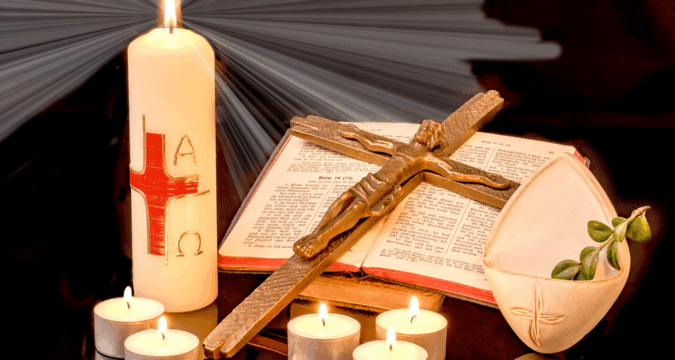
For John, the dark night is not a negative experience of pain per se, but an exodus journey where one is granted a share in the dying and rising of Jesus from Good Friday to Easter Sunday. It echoes the “night” in the Exultet sung during Easter Vigil as we watch the light of the Paschal candle grows gently out of the darkness.
It is a blessing in disguise, “sheer grace” as John puts it, when our darker side gives in to the light of God who bestows healing and sets free our capacity to love. Darkness becomes a harbinger of light; the time of waiting is but a time of preparation for God’s gifts.
Just as the Risen Christ bears the wounds of love on his body, Easter carries the memory of the Cross. True Paschal joy does not deny pain but transforms it—a transformation from within that effects a change of heart. In a spirit of perseverance in prayer and loving surrender, we go forth on our own exodus journey with Jesus—to accept small “deaths” in our own daily lives, to let go of our control, and to trust that God knows the way and is at work beyond our sight.
What Saint John of the Cross offers us is a powerful testimony to God’s silent work in our hours of darkness, a message of truth grounded in the Paschal Mystery of Jesus.
Through his writings, he invites us all to become “Easter people” to embrace hope in the midst of chaos, and, in so doing, become ourselves a beacon of light in our wounded world which is thirsting for God’s love.
“If we have died with Him, we shall also live with Him.” [2 Timothy 2:11] No matter what life’s quiet burdens you might be carrying right now, take heart. The dawn of real change, that of new life in our Risen Lord, is already breaking. Alleluia.
From 13 December 2025 to 26 December 2026, the Church is marking a Jubilee year for Saint John of the Cross in celebration of the 300th anniversary of his canonisation [1726] and the 100th anniversary of his declaration as a Doctor of the Church [1926]