Father Shay Cullen
Former Philippine president Rodrigo Duterte is currently being held in a private cell at the International Criminal Court [ICC] Detention Centre in Scheveningen, on the outskirts of The Hague. He is expected to have a solitary and austere birthday on 28 March, when he turns 81.
By then, it will have been a year since, with the cooperation of the current president, Ferdinand Marcos Jr., Duterte was arrested on an ICC warrant at Ninoy Aquino International Airport and subsequently flown to the Netherlands.
He is presumed innocent until proven guilty under Article 66 of the Rome Statute, the ICC’s governing document. Guilt must be established beyond reasonable doubt by the ICC prosecutor.
He faces three charges of crimes against humanity, alleging that he participated as an indirect co-perpetrator in systematic, nationwide attacks on civilians from 1 November 2011 to 16 March 2019. A confirmation hearing is scheduled for February 23–27 to determine if there is sufficient evidence to proceed to a full trial.
Duterte is accused of establishing the “Davao Death Squad” and of involvement in the killing of at least 19 people in Davao City, where he served as mayor, as well as other killings nationwide after he became president. When the death squad was still active in Davao, this writer campaigned to end the killing of street children by unidentified motorcycle-riding assailants. At that time, Duterte was in Congress and Benjamin de Guzman was mayor of the city.
The then-mayor charged me with defaming the city for protesting these killings. After over a year of legal battles, the day arrived for my arraignment and the start of my trial. In response to public outcry and extensive media coverage, the mayor sent a representative to the court at the last minute. He dramatically submitted a letter withdrawing the charges.
A positive outcome was that the killing of street children ceased and the charges were dismissed.
Duterte is accused of establishing the “Davao Death Squad” and of involvement in the killing of at least 19 people in Davao City, where he served as mayor, as well as other killings nationwide after he became president.
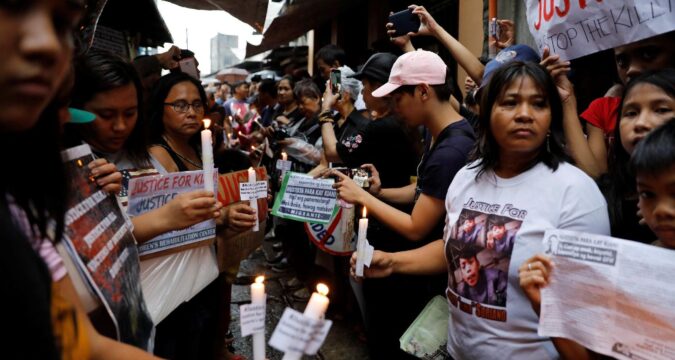
However, the killing of “suspects” continued. Human rights advocates have documented up to 30,000 people shot dead by unknown assailants. Government sources report that between 6,252 and 7,884 people were killed in police-led anti-drug operations. These victims were denied the presumption of innocence and trial, in contrast to the legal process Duterte now faces at the ICC.
As we celebrate the 500 years of Christianity in the Philippines. The Chaplaincy to Filipino Migrants organises an on-line talk every Tuesday at 9.00pm. You can join us at:
https://www.Facebook.com/CFM-Gifted-to-give-101039001847033
How could it be that, in a predominantly Catholic country, a shoot-to-kill candidate won a landslide victory in 2016 with over 16.6 million votes—39 per cent of the total cast? During his campaign, video reports show he promised to kill 100,000 criminals and dump enough bodies in Manila Bay that “the fish will grow fat.”
Other videos show him at a March 2016 rally declaring, “When I become president, I will order the police to find those people [dealing or using drugs] and kill them. The funeral parlours will be packed.”
He also encouraged armed citizens to participate, saying, “If you know any addict, go ahead and kill them yourself.” He even offered ‘medals’ to those who complied. Publicly, he told drug dealers, “My order is shoot to kill you. I don’t care about human rights; you better believe me.”
Despite this, 16.6 million Filipinos, many of them Catholics, elected him to office with a gun in his hand, so to speak.
Government sources report that between 6,252 and 7,884 people were killed in police-led anti-drug operations. These victims were denied the presumption of innocence and trial, in contrast to the legal process Duterte now faces at the ICC
Absent voices
A large majority of the population—as much as 88 per cent—continued to support him, fully aware that suspects were being killed as part of his so-called war on illegal drugs. They share some responsibility.
Missing were the voices of many who are meant to uphold Christian values and the sanctity of life. In 2017, there were 90 active bishops and about 40 honorary members of the Catholic hierarchy in the Philippines. Many remained silent, fearing Duterte’s threats to expose their alleged ‘sins.’ Only a few spoke out against the extrajudicial killings.
Among the bishops who spoke out were Pablo Virgilio “Ambo” David of Kalookan, one of Duterte’s most prominent critics; Socrates Villegas of Lingayen-Dagupan, Pangasinan; Broderick Pabillo of Taytay, Palawan; and Gerardo Alminaza of San Carlos, Negros Occidental.
Bishop (now Cardinal) David stated that his diocese was being turned into a ‘killing field’; Bishop Pabillo accused Duterte of blasphemy and urged legislators to investigate the killings; and Bishop Alminaza said the killings were a systematic policy, not random acts of violence.
When I become president, I will order the police to find those people [dealing or using drugs] and kill them. The funeral parlours will be packed
Rodrigo Duterte
Other notable dissenters included Bishop Ruperto Santos of Balanga, Batangas; Bishop Arturo Bastes of Sorsogon; Bishop Jose Colin Bagaforo of Kidapawan, Cotabato; and Bishop Teodoro Bacani of Novaliches. In 2019, the government filed charges of inciting sedition, cyber-libel, and obstruction of justice against Bishop David, Bishop Bacani, Archbishop Villegas, and Bishop Honesto Ongtioco. These charges were dropped in 2020 for lack of evidence.
Duterte also made appalling suggestions that ‘useless’ bishops should be killed or ‘decapitated.’ Many received death threats, and three priests—Father Marcelito Paez, Father Richmond Nilo, and Father Mark Ventura—were murdered amid the anti-Church campaign.
Other priests bravely took a stand, assisting victims’ families—such as Father Flaviano “Flavie” Villanueva, who was later recognised with the Ramon Magsaysay Award for his efforts.
Another priest, Father Albert Alejo, faced sedition charges alongside the bishops. Father Robert Reyes led protest funeral processions for slain victims. Several other priests assisted victims’ families by providing shelter and protection in churches and convents.
On 5 February 2017, the Catholic Bishops’ Conference of the Philippines finally issued a unified statement against the ‘reign of terror’ caused by the war on drugs.
Duterte also made appalling suggestions that ‘useless’ bishops should be killed or ‘decapitated.’ Many received death threats, and three priests…
The courageous stand of these bishops and priests against this reign of terror was also a lonely one. One wonders where the rest of the clergy were. There were 10,365 priests serving approximately 92.6 million Catholics at the time. Those who remained silent and ignored the call to oppose injustice and human rights violations in word and deed have much to answer for.
If the Catholic Church in the Philippines as an institution is content to offer only the sacraments as the path to eternal life, without faith expressed through action for justice, it is, as St. James famously declared, dead.
The hundreds of committed Filipino defenders of human rights, protectors of creation, children’s rights advocates, and the unjustly imprisoned who speak and proclaim the truth prophetically, work for justice in word and action, and suffer persecution for their faith are the true Christians.