By Christopher Khoo
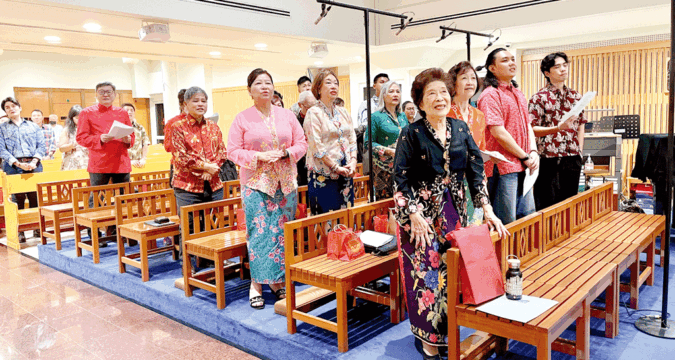
SINGAPORE (SE): It was a sea of colour at the Church of the Holy Family in eastern Singapore as Peranakan Catholics, dressed in traditional finery, descended on the church for the annual Peranakan Chinese New Year Eve Mass.
Peranakans are descendants of the early Chinese settlers in Southeast Asia who intermarried with local people. These unions resulted in a unique fusion of Chinese and local cultures such as language, attire and cuisine.
The men are called babas while the women are called nyonyas. The language they speak, Baba Malay, is a mixture of Malay and Hokkien, a Chinese dialect.
The February 16 evening Mass saw hundreds of attendees, dressed in Malay-style sarong kebaya for women and batik or Chinese-style baju lok chuan for men, attending the celebration spoken in their language. Assistant parish priest, Father Robertus Sarwiseso, an Indonesian, celebrated the Mass, while parish priest Father Adrian Yeo, who is himself a baba, concelebrated.
The choir sang hymns translated into Baba Malay.
In his homily, Father Sarwiseso urged the congregation to put Jesus first in their lives. He also noted that this was the first time in his 20 years working in Singapore that he had an opportunity to celebrate Mass in Baba Malay.
At the end of the celebration, he blessed the Mandarin oranges that were given to the congregation before Mass to bring home. Oranges are traditionally associated with good fortune and happiness during this festive season.
In a little speech at the end of Mass, Rocky Chan, who conducted the choir, shared that Singapore’s Peranakan Catholics had the church’s late parish priest, Father Alfred Chan, to thank for this special Mass.
Father Chan, himself a baba, started the annual Mass in 1984 to cater to the Peranakan Catholic community in the city-state, a large portion of whom reside in the east.
In Singapore, the Peranakan community has been facing a decline over the decades as members marry outside the community and younger members lose touch with their heritage as many of the older generation pass on.
The writer is a Singapore-based freelance journalist and educator.