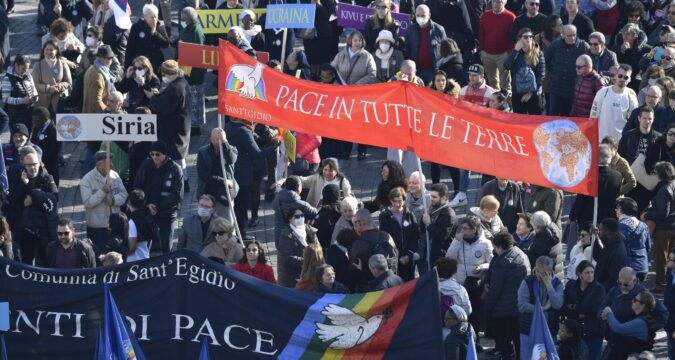
MANILA (LiCAS News): Catholic groups in the Philippines marked the World Day of Peace on December 31 by renewing calls for an “unarmed and disarming” peace that rejects violence, fear, and domination.
The groups urged governments and societies to root peace in justice, dialogue, and the protection of the vulnerable.
Pax Christi International aligned its appeal with the message of Pope Leo XIV, stressing that peace must be lived as a concrete moral commitment rather than treated as an abstract ideal.
Quoting the pope’s message for the 59th World Day of Peace [Sunday Examiner, January 4], Pax Christi said peace must be “unarmed and disarming,” rejecting “the logic of violence, fear, and domination,” and fostering “trust, dialogue, and the renewal of hearts and minds.”
The statement was signed by the group’s co-president Bishop Jose Colin Bagaforo of Kidapawan and Sister Wamuyu Teresia Wachira, a Kenyan member of the Institute of the Blessed Virgin Mary.
[Pax Christi International] growing temptation to weaponise even thoughts and words Pax Christi International
It said that the phrase, ‘Peace be with you!’ is not a mere greeting, but is a “call to transform our relationships, our communities, and our world,” adding that peace “demands that we embody justice, mercy, and reconciliation in our daily lives.”
The group said Pope Leo’s call addresses not only wars between nations but also “the structural and systemic violence that marginalises the vulnerable and fuels mistrust among peoples.”
Pax Christi International also warned against a “growing temptation to weaponise even thoughts and words,” urging instead “the disarmament of heart, mind and life,” and renewed commitment to prayer, dialogue, and nonviolence as paths to peace.
Echoing the global appeal, Caritas Philippines issued a New Year statement linking peace in the Philippines to social justice, ecological responsibility, and the lived realities of the poor.
As we celebrate the 500 years of Christianity in the Philippines. The Chaplaincy to Filipino Migrants organises an on-line talk every Tuesday at 9.00pm. You can join us at:
https://www.Facebook.com/CFM-Gifted-to-give-101039001847033
“This greeting is not a formality nor a distant hope,” it said. “It is an invitation and a challenge—calling us to choose what kind of nation we will be in the year ahead.”
…for countless Filipino families burdened by poverty, violence, displacement, and insecurity, peace is not an abstract ideal. It is the difference between fear and hope, between exclusion and belonging
Bishop Gerardo Alminaza
Bishop Gerardo Alminaza of San Carlos, president of Caritas Philippines, rejected security approaches rooted in force, stressing that the peace of Christ “is not sustained by fear, force, or weapons,” but is “unarmed and disarming, humble and persevering.”
The bishop said peace remains fragile when “livelihoods are denied,” “ancestral lands are threatened,” “human dignity is violated,” and “the poor are treated as expendable,” particularly in communities affected by “armed conflict, political violence, red-tagging, and the criminalization of dissent.”
Bishop Alminaza noted that “for countless Filipino families burdened by poverty, violence, displacement, and insecurity, peace is not an abstract ideal. It is the difference between fear and hope, between exclusion and belonging.”
Caritas Philippines also linked peace to ecological justice, describing environmental destruction as “a silent but persistent form of violence against the poor,” warning that “peace is broken long before a gun is fired.”
“Ecological justice, therefore, is not optional. It is essential to a just and lasting peace,” the organisation said.
It cautioned against the misuse of the language of “development,” “order,” and “security” to justify harm, silence communities, and normalise suffering, stressing that peace requires justice, solidarity, and the protection of human dignity.
“Peace begins with the disarmament of the heart and is sustained by solidarity,” Caritas Philippines said, committing to be communities “where justice is practiced, creation is respected, dignity is upheld, and hope is kept alive.”